Sign In
Create Account
BIDDERS
SELLERS
Top 20 visited live Items on LiveAuctioneers
1.
Lot # 1503: A SILVER MOUNTED IVORY TOPPED ‘EROTIC’ WALKING CANE. 3ft 1ins long.
2,670 visitors
2.
Lot # 1476: Margot Kidder (1948- ) Canadian-American actress. Kidder appeared in a wide range of films during the 1970s and 1980s such as Sisters, Black Christmas, The Great Waldo Pepper, The Amityville Horror and Heartaches. She is best known for her role as Lois Lane in four Superman movies opposite Christopher Reeve. 8” x 10” black and white nude photograph signed.
2,430 visitors
3.
Lot # 610: Titled Camp Harmony, this large original watercolor from the famous sporting artist measures 37" x 27" framed, with image size of 16" x 26 1/4". Ogdan Milton Pleissner (1905-1983) was born in Brooklyn, NY, however became involved with the outdoors while summering in Wyoming during his youth. Serving with the Army Air Corps during the second World War as a correspondent for Life magazine, Pleissner portrayed scenes from Europe using watercolors as his medium, predominantly for the fast drying properties vs. using slow drying oils. Moving to Southern Vermont in 1947, Pleissner continued to use watercolors to produce some of this nation's most coveted angling paintings, with many museum displays focused on his work. Offered here is a rare opportunity to add an original work from the celebrated artist. Signed in the lower right corner, in excellent condition throughout.
2,196 visitors
4.
Lot # 6306: French School (19th century), Erotic Scene, miniature (oval) portrait, signed indistinctly lower center right, sight: 1.625"h x 2.375"w, overall (with period frame): 1.875"h x 1.875"w
1,924 visitors
5.
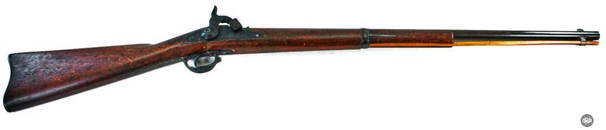
Lot # 150: Bill Dalton's 1876 Winchester 45-60 Ser # 23082 - Owned and used by Bill Dalton. Provenance: Gun taken from Bill Dalton by E.W. Kay when he arrested him near Cross Creek station in September of 1891. He was arrested for the Ceres train robbery attempt. Later Stamped ETC (Evidence Tulare County) as Kay wanted Bill to stand trial. Acquired by Author Frank Latta directly from Sheriff Kay, then sold by Latta's Grandson at the dispersal of Frank Latta's Estate to the present owner and former Gunsmith Larry Thompson of Watsonville, California. An important collection of original documents, telegrams and correspondence between E.W Kay and Frank Latta were observed by California Auctioneers at the Exeter, California Museum - in reference to the Dalton Winchester Serial # 23082. The documents were provided from the Frank Latta archives, under the direction of Chris Brewer, California Historian & Publisher. The firearm appears prominently in Frank Latta's Book "Dalton Gang Days" on page 245. Includes Documentary about the history of the Rifle, First edition copy of Frank Latta's Book "Dalton Gang Days", notarized Letter from Larry Thompson, and Winchester letter from the Cody Firearms Museum. After searching for Dalton Sheriff E.W. Kay and His Deputy Jim Ford (Bob Ford's cousin, who shot Jesse James) waited outside Maggie Ruggle's Farm near Cross Creek Station. One of the young girls spotted them and 'acted like she didn't see them,' Kay reacted quickly, and sent Ford to drive the Buckboard past the front and around the house. Kay went to the front of the house and asked Ruggle if Bill was there. She said no, but seeing in her eyes, he was - he quietly pushed his way in with his revolver, and saw the back room door slightly ajar. He observed Bill looking out the back window watching Jim Ford driving the buckboard and the Winchester (Serial #23082) leaning against the window sill. Kay opened the door with the barrel of his revolver, he could see Dalton wanted to grab his Winchester, but they both knew he would never make it. Dalton was then arrested and Kay took the Winchester as evidence. As Kay wanted Dalton to go to trail and not hang, he stamped the barrel ETC (Evidence Tulare County). Bill Dalton Came to California at age 20. The first documented Dalton gang train robbery occurred at Alila, (now Earlimart) California in 1891, the second was at Cross Creek station in Ceres, California. He was arrested, but acquitted. The Dalton's went back to Indian territory, after which Bob and Gratt were killed in their failed double bank robbery attempt in Coffeyville, Kansas, Oct. 1892. Emmett was shot 14 times but lived. Latta was told by Littleton Dalton that Bill didn't make the robbery because his horse went lame, after which he became extremely bitter because of the deaths of his brothers in Coffeyville. He then formed the Dalton - Doolin Gang ~ Known as the Original WILD BUNCH. Few know why the once California politician went so far from the law. Perhaps it started when his older brother, US Marshall Frank Dalton's murder lacked justice within the law, or perhaps it was the culture of the period. Many think it was the brutality in which his brothers were killed and displayed at Coffeyville that unleashed arguably the first outlaw gang leader of the Western plain that had every small town in the west cowering in fear and their banks up in arms as they bought up armaments to fortify his coming. Bill Dalton met his demise after the Longview Texas bank robbery in 1892 near Poolville Oklahoma when surrounded by deputies in his attempt to escape. The eagles Desperado may have asked the right questions about Bill Dalton as he was the subject. Both Bill and his brothers were a product of the swiftly changing times of the West. Skilled mule slickers who once were making the trip from homesteading Californians in Bakersfield and Visalia all the Way to Oklahoma 4 or 5 times a year, their unique skills of passage and daring infringed by the coming of the train. The irony of them committing (arguably) the first train robbery in California is perhaps not a surprise. It is said they went as far west as Paso Robles, California. They were truly the trailblazers of the American west, and the world of weapons steel and trains, changed the brothers, until the brutal end. Certainly the Dalton ~ Brothers ~ gang represent a part of the violent history of the 1890's - from California to Coffeyville. Sheriff E.W. Kay tracked the Gang for six thousand miles after Gratt's (Dalton) escape from the Tulare county jail in Visalia, California, but never caught them. He was a true blue Sheriff spending his life savings in the process.
1,908 visitors
6.
Lot # 179: Philip Leslie Hale (Massachusetts, 1865-1931), "La Donna" ("Mi Velata"), oil on canvas painting depicting a young woman in white dress with enigmatic expression, looking out from behind a "veil" of black lace curtains. Housed in a handcarved and painted wooden frame. 39"H x 25"W sight, 45"x 31" framed. Provenance: the estate of Margaret Wemyss Connor, Nashville, TN; Sotheby's December 1st, 1998 sale, lot 00172; private collection; Vose Galleries, Boston; the artist (detailed notes available on request). Biography: A member of the Boston School of painters, Philip Leslie Hale's reputation as an artist was somewhat overshadowed during his lifetime by his teaching and writing. As a young man he studied painting at the Boston Museum School with Edmund Tarbell (who remained an indelible influence), privately with William Merritt Chase, and at the Art Students League in New York with J. Alden Weir. He furthered his art education in Europe, studying in Paris at the Academie Julien and the Ecole des Beaux Arts, and visiting the major museums of Europe, where he was said to be influenced by the French Impressionists Sisley and Pissarro and by Vermeer. He lived in Giverny for a time and was acquainted with Claude Monet. After studying abroad for over a decade, he returned to America and was given a one man show. Although he painted a variety of subjects over the years, he is best recognized for his decorative paintings of the female figure and his landscapes. In 1902 he married respected fellow artist Lillian Westcott Hale. Philip Hale went on to build a reputation as an instructor, critic and writer, teaching at the Boston Museum School and the Pennsylvania Academy of Fine Arts, and authoring several books (including a study on Vermeer in 1913). A retrospective of his work at Vose Galleries of Boston in 1966 helped reignite interest in his paintings. Source: Michael David Zellman, "300 Years of American Art," Vose Galleries, Pierce Galleries.
1,796 visitors
7.
Lot # 6233: LeRoy Neiman (American, 1921-2012), "Finish at Indy," 1982, oil on board, signed and dated lower right, board: 48"h x 48"w, overall (with frame): 58.5"h x 58.5"w
1,769 visitors
8.
Lot # 1512: Brinke Stevens. Two color 8” x 10” nude photographs signed. One with a guitar to second with a nude friend.
1,758 visitors
9.
Lot # 14: Original "Apple 1 Computer", 1976 This is the sensational 1st product of today's highest-valued company (approx. 600 billion US$). – The "Apple 1" was designed and handmade by Steve Wozniak in the famous "electronics heaven" of "Silicon Valley", USA, and was marketed in April 1976 by Wozniak and Steve Jobs through electronics retail chain, the "Byte Shop", which bought the first 50 units. – The "Apple 1" was always delivered as a motherboard only and is seen here with the very rare original "NTI" sign. The peripheral equipment such as power pack, keyboard, monitor and cassette recorder had to be obtained personally by the user. "Apple" never offered a housing; every user had to make his own. – The "Apple 1" was the 1st PC in the world with monitor and keyboard access! – The peripheral items are authentic and correspond to the motherboard as recommended by "Apple". – Only 200 examples of the "Apple 1" were ever made. According to the highly regarded "Apple 1 Registry" by Mike Willegal (www.willegal.net), today there are only 46 (!) sets in existence worldwide, but just 6 of these are in fully-working condition, and the example offered here is one of those! – We prepared a video demonstration which you'll find on YouTube.com/AuctionTeamBreker. The demo shows the direct input into the WOZ-monitor: The "Apple 1" did not have an operating system, just a so-called "monitor" program which provided the interface between keyboard entry – CPU – memory and monitor exit. Any more sophisticated software system – like "Basic" – had to be loaded on cassettes. Therefore, a cassette-interface-card, offered optionally by "Apple", was required. This present set contains the original card and the original early "6502 micro processor" in rare white ceramic design! The software cassettes are authentic reproductions. – "Basic" was available for the "Apple 1" at the beginning of 1977 only. In February 1977 "Apple" changed its first logo depicting Isaac Newton under a "paradisical" apple tree to the one which is still used today. The original "Apple 1 Manual" included here still shows the primary logo. – To date, the only two fully-working "Apple sets" in comparable condition to the one here, were auctioned in 2012: by Sotheby's New York on 15 June for US$ 374,500 and on 24 Nov. by Auction Team Breker in Cologne, Germany for US$ 640,000 (€ 491,868). – Today's "Apple 1" computer set is 100 % authentic and in fully working condition ... and it is already signed personally by its inventor and manufacturer Steve Wozniak. – Also enclosed is an original company letter from 1978 signed by Steve Jobs, and addressed to the U.S. Baseball legend Fred Hatfield, whom he offers to exchange his "Apple 1" plus a check about $400 for the new "Apple 2"... – The "Apple 1" is already a legendary milestone from the dynamic dawn of the personal computer age … and a legendary symbol of the "American Dream" too! Watch & Listen on: YouTube.com/AuctionTeamBreker Original-"Apple 1 Computer", 1976 Das sensationelle erste Modell des heute – nach nur 35 Jahren – wertvollsten Unternehmens aller Zeiten (ca. € 500 Mrd.). – Der "Apple 1" wurde von Steve Wozniak im "Silicon Valley, CA" entwickelt und gebaut und erstmals im April 1976 von ihm und Steve Jobs für $ 666,66 über die Elektronik-Ladenkette "Byte Shop" angeboten. – Der "Apple 1" wurde nur als Platine ausgeliefert, hier mit der äußerst seltenen Original-Bezeichnung "NTI". Die Peripheriegeräte wie Netzteil, Tastatur, Monitor und Kassettenrekorder mussten sich die Käufer selbst besorgen. Ein Gehäuse hat "Apple" nie angeboten, jeder Besitzer konnte es sich nach eigenem Gusto selbst anfertigen. – Der "Apple 1" ist der erste PC der Welt mit Monitor- und Tastaturanschluß! – Das hier angebotene Set entspricht absoluter Authentizität der Peripherie, wie sie von "Apple" empfohlen wurde. – Nur 200 Stück des "Apple 1" wurden je gebaut. Laut dem absolut führenden "Apple 1 Registry" von Mike Willegal (www.willegal.net) sind heute nur noch 46 (!) Exemplare weltweit bekannt. Davon sind nur 6 Stück in funktionsfähigem Zustand, das hier angebotene Set zählt dazu! – Unser Demo-Video des hier angebotenen Sets finden Sie auf Youtube.com/ AuctionTeamBreker. Die Demonstration umfaßt direkte Eingaben in den WOZ-Monitor: Der "Apple 1" hatte kein Betriebssystem, lediglich ein sogenanntes Monitor-Programm stellte die Schnittstelle zwischen Tastatureingabe – CPU – Memory und Monitorausgabe her. Ein höheres Betriebssystem – wie BASIC – musste von Kassette geladen werden. Dazu benötigte man eine Cassette-Interface-Karte, die optional von "Apple" angeboten wurde. Im vorliegenden Set ist eine Original-Karte (!) im Einsatz, außerdem der äußerst seltene und frühe Original "6502 Mikroprozessor in weißer Keramik-Ausführung". Die Software-Kassetten sind authentische Reproduktionen. BASIC war erst Anfang 1977 für den "Apple 1" verfügbar. Ab Februar 1977 verwendete "Apple" das bis heute bekannte Apfel-Logo als Firmenzeichen. Das hier vorliegende Original "Apple 1 Manual" zeigt noch das ursprüngliche Apple-Logo mit Isaac Newton unter einem "paradiesischen" Apfelbaum liegend. – Die beiden 2012 verkauften voll funktionsfähigen und in ähnlich gutem Zustand befindlichen "Apple 1" wurden am 15. Juli bei Sotheby's in New York für US$ 374.500 bzw. am 24. Nov. beim Auction Team Breker in Köln für US$ 640.000 (€ 491.868) versteigert. – Dieser hier angebotene "Apple 1" ist 100% authentisch und voll funktionsfähig ... und ist bereits persönlich signiert von seinem Erfinder und Erbauer Steve Wozniak. – Ebenfalls dabei ist ein Original-Geschäftsbrief mit "Apple"-Firmenkopf von 1978, unterzeichnet von Steve Jobs und gerichtet an Fred Hatfield, der bereits 1998 verstorbenen U.S.-Baseball-Legende, dem Steve Jobs anbietet, seinen "Apple 1" umzutauschen gegen einen "Apple 2", wenn er einen Scheck über $400,- beilegt... – Der "Apple 1" ist bereits ein legendäres Highlight der großen, jungen Computer-Geschichte! Watch & Listen on: YouTube.com/AuctionTeamBreker
1,626 visitors
10.
Lot # 57: Unique outfit of original Leitz gold plated 'Luxus' camera with brown lizard leather covering and 2 gold plated lenses (Summar 2/5cm no.190131, Elmar 3.5/3.5cm no.182545). History of this outfit: It comes from the estate of the famous German sparkling pro
1,600 visitors
11.
Lot # 656: Atom Jet a- 58v, Made in Japan, c1954, litho. tin, friction - 30"l. Largest of the toy cars made in the 1950's, in great original condition, works Very Rare
1,598 visitors
12.
Lot # 4060: Nude girl and boy on terrace. Circa 1900. Albumen print. 16,5 x 21,5 cm. Photographer's Roma, 34, Via Sardegna stamp and number 10526 in blue crayon on the verso. A few light handling marks, otherwise in near excellent condition.
1,493 visitors
13.
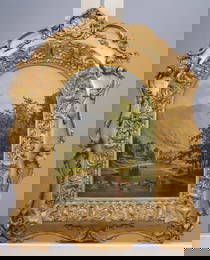
Lot # 322: Rare Moorish Revival Mantel Clock, Tiffany & Co. brass and copper architectural elements are applied to the black slate and variegated marble. This impressive clock features minarets centered with a Moorish dome having a gallery surround. The face plate, with Arabic numerals and time and chime apertures, is set into marble and supported by six Corinthian columns, the case itself raised on scrolled feet reminiscent of a Moorish slipper. The face plate is signed "Tiffany" above the #6. The back is stamped "Tiffany & Co. New York 7925." 32 x 14.5 x 7.5 in. Moorish Revival became a popular design movement in the wake of Orientalist Romanticism during the late 19th century. Louis Comfort Tiffany designed Moorish themed items for the interior of the Henry Osborne Havemeyer residence on 5th Avenue, constructed first half of the 1880s, and this clock is possibly one of these special creations in collaboration with Tiffany & Co. prior to Louis's departure from the firm. Private Collection, Charlotte, NC
1,483 visitors
14.
Lot # 99B: 2003 Mercedes Benz SL500 hard top convertible..Low low miles - less than 35,000. Excellent condition. V8 with all the bells and whistles. New hydraulics for convertible top. New tires. Well maintained. Excellent running condition. vin # WDBSK75F13F032092.
1,398 visitors
15.
Lot # 327: A carved throne chair which, among collectors of Chinese furniture, is considered the highest form of chair, and only emperors were permitted to sit in it. Most were made in the middle of the Qing Dynasty, (1644-1911), and although replete with delicate and sophisticated carving, they often had large images that would please the emperor. The woods used in making these chairs were usually now considered rare woods that were very hard and durable, such as Zitan, the wood used in this example. in accordance with the Chinese concept of a bed being the center of the house, so the style of a throne still resembles a bed in shape. 50" X 32 1/2" X 43"Shipping: We are unable to ship this item. Please contact our local UPS Store, store1152@theupsstore.com, or the Packaging Store, hello@packandshipnow.com, for a quote. Please be sure and include your shipping address, a description of the lot, including any dimensions, the speed at which you will need it shipped and the amount you would like to insure it for. You may also hire your own third party shipper, they must be willing to pick the item up from us.
1,380 visitors
16.
Lot # 6307: French School (18th century), Erotic Scene, miniature (circle) portrait, signed indistinctly lower center, sight (circle): 2.6275"h x 2.6275"w, overall (with period frame): 2.875"h x 2.875"w
1,378 visitors
17.
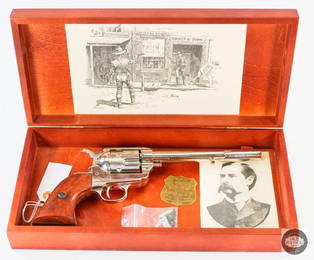
Lot # 149A: 1873 Pinched Frame Single Action Revolver Serial Number 154. Nickel finish, 7½ round barrel, original, walnut grips. Manufactured mid 1873, shipped June 23rd 1874; possibly 'the highest recorded 1873 Colt pinch frame' ~ a true collectors relic. The pinched frame area of the Right groove is different from most known Pinched frame's and is believed to be a transitional trait as this revolver was within the last lot of Pinched frame revolvers manufactured. The "U.S." on the left frame was applied by Colt in Anticipation of the US Government contract ~ a plus to this rare pinched frame revolver. This is one of the rarest Colts of the pinched frame family. A true "one of a kind" this revolver has never been offered for sale, with a letter of authentication by John Kopec, an authority and author in the field of Colt single action.
1,363 visitors
18.
Lot # 371: Ken Wood, homoerotic naval stipple pen drawing, framed, not examined out of frame, depicting men wrestling, ship in background, signed and dated "Kenwood" and "1979," label on verso. 12 1/2" high, 17" wide.
1,363 visitors
19.
Lot # 4116: Female nudes. Circa 1995/96. 5 vintage toned matte gelatin silver prints. Various sizes between 20 x 17 cm and 13 x 18 cm. 1 signed and editioned 2/30 by the photographer in ink in lower margin, each mounted to board. In very good condition. Lit.: Günter Blum. Erotisches Tagebuch. Frankfurt 1999, ill. p. 34 (variant).
1,353 visitors
20.
Lot # 4061: Nude girl and boy on terrace. Circa 1900. Albumen print. 22,3 x 16,8 cm. Number 10510 in blue crayon on the verso. A few light handling marks, otherwise a rich print in near excellent condition.
1,340 visitors