FINE ANCIENT ART, ANTIQUITIES & COINS 2023-01-29 Auction - 491 Price Results - Apollo Art Auctions in United Kingdom
FINE ANCIENT ART, ANTIQUITIES & COINS
IMPORTANT MARBLE PORTRAIT OF A SEVERAN LADY, POSSIBLY JULIA DOMNA
RARE GREEK CORINTHIAN BRONZE HELMET
RARE EGYPTIAN CARTONNAGE MASK

Auction Closed

FINE ANCIENT ART, ANTIQUITIES & COINS

Closed
London, United kingdom, United Kingdom
Apollo Art Auctions are delighted to present their first sale of 2023 - Fine Ancient Art, Antiquities & Coins. The catalogue encompasses a broad range of well-provenanced and expertly authenticated artifacts from Classical Europe, through Egypt and the Near East, as well as many treasures from India and China. The catalogue is divided into four sections: commencing with Classical and Egyptian Antiquities, followed by Medieval Works of Art, Asian Works of Art and finishing with a great selection of Ancient Coins. Some of the highlights of this sale include Lot 1 Attic Black-Figure Whiteground Lekythos an artefact with royal provenance belonging to the Second Marquess of Northampton. Lot 6 Rare Egyptian Cartonnage Mask and Lot 7 Large Egyptian Limestone Stele King of Upper Egypt Middle Kingdom With Report, beautiful and important Egyptian pieces. Lot 23 Rare Apulian - Lucanian Red-Figure Volute Krater - TL Tested and lot 24 Apulian Greek Red Figure Column Krater - TL Tested a great examples of high-end Greek pottery. Lot 50 Rare Greek Corinthian Bronze Helmet an iconic and desired type of helmet in great quality. Lot 51 Greek Bronze Winged Helmet - ex. Axel Guttmann an extraordinary Greek helmet of rare type and famous provenance. Lot 59 Important Marble Portrait of a Serveran Lady, Possibly Julia Domna, an astonishing Roman sculpture captured by the artist in timelessly beautiful marble. Lot 63 Large Roman Marble Venus, a playful representation of the goddess Venus in large size. Lot 65 A Bronze Statuette of Jupiter Depicting Zeus Brontaios an important Roman bronze figure modelled after a Greek original by the famous sculptor Leochares
SOLD
ATTIC BLACK-FIGURE, WHITEGROUND LEKYTHOS: Ca. 490-480 BC. Attributed to the Athena painter. This vase depicts a scene from a centauromachy, showing a hoplite soldier on one knee, thrusting the point of his spear into his opponent's
Est.
£20,000
-
£40,000
SOLD
EGYPTIAN STONE FIGURE OF OSIRIS – MUSEUM EXHIBITED: Ca. 664-332 BC, Late Dynastic Period. An Ancient Egyptian stone statuette depicting the god Osiris. He is shown seated in mummiform with a braided divine beard, an atef-crown, and a peaceful,
Est.
£20,000
-
£40,000
SOLD
ETRUSCAN TERRACOTTA VOTIVE YOUTH HEAD - TL TESTED: Ca. 400-200 BC. A terracotta votive of hollow form depicting a young male. His young visage comprises of large almond-shaped eyes, incised pupils, a prominent aquiline nose, full bow -shaped lips,
Est.
£15,000
-
£30,000
SOLD
A ROMAN BRONZE FIGURE OF A GODDESS, POSSIBLY JUNO: Ca. 100 - 300 AD. Wearing a heavily draped chiton with a knotted belt beneath the breasts and wrapped in a himation falling from her proper left shoulder and across her waist, her right arm
Est.
£15,000
-
£30,000
SOLD
GREEK CANOSAN TERRACOTTA DANCING WOMAN - EX CHRISTIES: Ca. 200 BC. Perhaps from Centurpipe, Sicily, depicted wearing a chiton, her body twisting spirally to the right, head thrown back and turned sharply to her right. Left leg raised behind her, arms
Est.
£15,000
-
£30,000
SOLD
RARE EGYPTIAN CARTONNAGE MASK: Ptolemaic Period, Ca. 332-30 BC. An ancient Egyptian cartonnage mask of timeless beauty depicting the deceased who is shown wearing a tripartite wig, the lappets of which fall gently behind the ears
Est.
£20,000
-
£40,000
SOLD
LARGE ANCIENT EGYPTIAN GILT WOOD AND BRONZE IBIS: Late Period to Ptolemaic Period, Ca. 664-32 BC. An ancient Egyptian gilt wood and bronze Ibis depicted seated, the body sculpted in wood, covered in gesso and gilt, the closed wings articulated, the
Est.
£6,000
-
£12,000
SOLD
ANCIENT EGYPTIAN BRONZE OSIRIS VOTIVE FIGURE: Late Dynastic Period, Saite Period. Egyptian, Ca. 664-332 BC. A bronze figure of Osiris standing mummiform with his hands emerging from his cloak, holding the crook and flail, and wearing a broad
Est.
£1,500
-
£3,000
SOLD
LARGE EGYPTIAN MAAHES STATUETTE: Late Period - Ptolemaic Dynasty, c. 663-30 BC. Statuette of the war god Maahes enthroned on a modern stand. His leonine head is adorned with a nemes headdress and a false beard, and his hands are
Est.
£750
-
£1,500
ANCIENT EGYPTIAN SILVER OSIRIS ON STAND: Late Period, 26th Dynasty, Ca. 664-525 BC. A silver votive figurine of Osiris wearing an atef crown, plumed on each side with ostrich feathers and decorated on the front with a uraeus cobra. The
Est.
£750
-
£1,500
Lot Passed
SOLD
ANCIENT EGYPTIAN TERRACOTTA USHABTI: New Kingdom, 19th - 20th Dynasty, Ca. 1292-1085 BC. A well-moulded terracotta ushabti, wearing the tripartite wig, holding hoe and mattock, basket on the back, details painted in black and red. A
Est.
£750
-
£1,500
SOLD
ANCIENT EGYPTIAN TERRACOTTA USHABTI: New Kingdom, 19th-20th Dynasty, Ca. 1292-1085 BC. A terracotta ushabti figure modelled in stylised mummiform pose with hands crossed over the chest, wearing an illustrious tripartite wig; all details
Est.
£750
-
£1,500
SOLD
LARGE ANCIENT EGYPTIAN CEDAR WOOD FIGURE: Late Period - Ptolemaic Dynasty, c. 663-30 BC. Ancient Egyptian Carved Wood Female Figure late period c.630-300 BC. Size 15 1/4 inches high. Large wood female figure of an Offering Bearer, with
Est.
£1,500
-
£3,000
SOLD
EGYPTIAN WOOD FEMALE OFFERING BEARER: Late Period - Ptolemaic Dynasty, c. 663-30 BC. A polychromy wooden female figure with a basket on her head and a water vessel in her right hand. She is depicted striding forward, wearing a short wig
Est.
£1,500
-
£3,000
SOLD
EGYPTIAN CARTONNAGE MUMMY MASK: Roman Period, Ca. 100 AD. Lovely face mask of plaster or stucco over linen; with handsome features painted in yellow and reddish pigments, the eyes and lashes in black pigment. The wig in raised
Est.
£750
-
£1,500
SOLD
AN ANCIENT EGYPTIAN WOOD SARCOPHAGUS MUMMY MASK: Late Dynastic Period, Ca. 664-32 BC. A carved sarcophagus mask formed from a finely grained cedar wood. The countenance presents with bulging almond-shaped eyes, a broad nose with flared nostrils,
Est.
£750
-
£1,500
SOLD
EGYPTIAN ALABASTER JAR: New Kingdom, Ca. 1550-1070 BC. The vessel of piriform shape smoothly tapers to a narrow flat base, standing on an everting foot, with a short cylindrical neck and thick, flat disc rim. Cf. el-Khouli,
Est.
£750
-
£1,500
EGYPTIAN RED BURNISHED POTTERY ALABASTRON: Ca. 2050-1786 BC. A beautifully modelled cylindrical vessel of alabastron form, the cylindrical body tapering to the pointed base, the plain rim painted with a band of black slip. The vessel was
Est.
£750
-
£1,500
Lot Passed
RARE EGYPTIAN ALABASTER MACE HEAD: Pre-Dynastic, Ca. 3500-3000 BC. A rare piriform alabaster mace head with a cylindrical drill hole in the centre for attachment to a wooden handle. Maces were extensively used in Egypt and
Est.
£3,000
-
£6,000
Lot Passed
SOLD
PTOLEMAIC GOLD SEAL RING WITH GRYPHON: Ca. 400-300 BC. Hellenistic Period, possibly from Egypt. A beautiful gold finger ring composed of a round hoop and a large bezel engraved with a lion-headed gryphon (griffin) depicted in flying
Est.
£6,000
-
£12,000
SOLD
HUGE PHOENICIAN GLASS PASTE FACE BEAD: Ca. 400-300 BC. A charming janiform pale blue glass bead with a cylindrical body drilled vertically for suspending. The exterior is decorated with two human faces with applied eye beads and densely
Est.
£1,500
-
£3,000
SOLD
RARE APULIAN-LUCANIAN RED-FIGURE VOLUTE KRATER - TL TESTED: Ca. 400 BC. A large and impressive red-figure painted terracotta vessel, standing on a pedestal foot, having two opposing handles at the shoulder, and two additional handles arising from the shoulder
Est.
£20,000
-
£40,000
SOLD
APULIAN GREEK RED FIGURE COLUMN KRATER - TL TESTED: Ca. 350-300 BC. A large and superb Apulian pottery Column krater with a decorative frame. From right to left, on the A-side a scene of a seated draped woman wearing a stylised chiton fastened below
Est.
£20,000
-
£40,000
SOLD
VERY LARGE APULIAN SKYPHOS: Ca. 370-360 BC. A very sizeable and attractive red-figure painted skyphos (wine cup), depicting (on side A) a winged nude Eros in profile, riding a horse adorned by a petite dolphin brand on its
Est.
£10,000
-
£20,000
SOLD
APULIAN RED-FIGURE OINOCHOE: Attributable to the Iliupersis Painter, Ca. 370-350 BC. An attractive blackware oinochoe with a nicely delineated foot, a rotund body, a cylindrical neck that rises to a carefully modeled trefoil
Est.
£4,000
-
£8,000
SOLD
GREEK APULIAN RED-FIGURE LEKANIS: Ca. 350-300 BC. Beautifully painted, lidded lekanis of typically elegant form, the shallow bowl painted in black, standing on a stemmed foot and with the lid with knopped finial handle. The main
Est.
£1,500
-
£3,000
SOLD
GREEK ATTIC POTTERY STEMMED KYLIX - TL TESTED: Ca. 500-400 BC. A beautiful Attic pottery kylix decorated via the black-figure technique on the exterior walls of both sides, hemispherical body with two lug handles, featuring a central horse and
Est.
£4,500
-
£9,000
LARGE ETRUSCO-CORINTHIAN AMPHORA: Near the Bearded Sphinx Painter, Ca. 600 BC. A pottery amphora of a classic form, with a bulbous body upon a raised, round foot, a flared rim at the top and gracefully curved twin handles adjoining
Est.
£7,500
-
£15,000
Lot Passed
SOLD
GREEK SOUTH ITALIC POTTERY PATERA: Subgeometric III, Ca. 4th century BC. With a rosette in the tondo enclosed within a band of alternating lines and dots, framed by thick, plain bands, a band of ivy below the rim, light-brown umber
Est.
£1,500
-
£3,000
GREEK CORINTHIAN DECORATED KOTHON: Archaic Period, ca. 6th-5th century BC. A decorated pottery kothon with a smooth burnished, cream-color slipped surface and delicate black and red decorative lines around the rim and interior. A loop
Est.
£1,500
-
£3,000
Lot Passed
CYPRIOT BLACK ON RED WARE POTTERY BOWL: Cypro-Archiac, Ca. 750-600 BC. A beautiful thin-walled bowl of slightly elliptical form, with twin handles and ring base. The black-painted decoration on the exterior consists of bands of concentric
Est.
£3,000
-
£5,000
Lot Passed
SOLD
LARGE CYPRIOT BRONZE AGE TERRACOTTA AMPHORA: Ca. 2300-1650 BC. An attractive red slip ware amphora with a bulbous body, slim cylindrical neck, tubular rim, and two handles joining shoulder to neck. Amphorae such as this were used to hold and
Est.
£750
-
£1,500
VILLANOVAN POTTERY VESSEL: Ca. 700-600 BC. A one-handled pottery vessel of a wide, globular body on a flat ring foot. The shoulder is broad, with two bands of incised decoration flanking multiple protrusions. Cylindrical neck
Est.
£1,500
-
£3,000
Lot Passed
SOLD
PAIR OF LARGE ETRUSCAN BUCCHERO OINOCHOE: Ca. 500 BC. Molded in bucchero "pesante", these oinochoe have an ovoid body, trefoil mouth, two plastic rotelles on the rim, a disc-shaped foot, and a handle stretching from the rim to the shoulder.
Est.
£3,000
-
£6,000
SOLD
ETRUSCAN TERRACOTTA VOTIVE HEAD OF A WOMAN: Ca. 400-200 BC. Depicted with her hair arranged in multiple curls, with tresses falling at the sides, a veil drawn up over her head. Item comes with a professional historical report from Ancient
Est.
£6,000
-
£12,000
SOLD
HELLENISTIC SILVER PHIALE: Ca. 400-300 BC. A museum-quality bowl hammered from a single sheet of silver with underside low-relief decorated with numerous embossed amphorea designs surrounded by a circumferential band of
Est.
£3,000
-
£6,000
SOLD
HELLENISTIC GOLD BROOCH WITH AGATE EYE: Ca. 300-100 BC. A finely rendered Greek Hellenistic gold disc-shaped brooch/pendant, hammered from thin gold, with an agate eye to the centre. The obverse is finely decorated with dense filigree
Est.
£1,500
-
£3,000
SOLD
LARGE HELLENISTIC GOLD RING WITH ONYX INTAGLIO PORTRAIT: Ca. 300 BC. A beautiful gold ring with a hollow circular band and an oval black gemstone with an intaglio depicting a left-facing portrait of a female. She is displayed with an elegantly styled
Est.
£3,000
-
£5,000
SOLD
ANCIENT GREEK GOLD ARCHITECTURAL RING WITH GARNET: Ca. 200 BC. A stunning gold ring composed of a D-shaped hoop with its arms terminating in architectural form with a hinged mechanism. The raised bezel features a large cell with a garnet cabochon
Est.
£3,000
-
£5,000
SOLD
GREEK HELLENISTIC GOLD PENDANT WITH DOLPHINS: Ca. 300 BC. An amphora-shaped pendant comprising a central shaft threaded with a large piriform coral bead secured at the bottom with a large sphere. The looped finial, serving as a suspension ring,
Est.
£750
-
£1,500
URARTIAN BRONZE HELMET: Ca. 800-700 BC. A helmet formed of hammered bronze sheet of conical form with two bands of horizontal raised ribs around the bottom edge. The helmet is decorated with repoussé rib to the forward
Est.
£7,500
-
£15,000
Lot Passed
SOLD
RARE GREEK CORINTHIAN BRONZE HELMET: Ca. 600 BC. A bronze combat helmet of Archaic Corinthian-Type, hammered from a single sheet of bronze with finely contoured almond-shaped eyes that gently taper to a point. Simplistic curvilinear
Est.
£60,000
-
£120,000
SOLD
GREEK BRONZE WINGED HELMET - ex. Axel Guttmann: Ca. 400 BC. A bronze helmet forged from a single hammered sheet with a finely central crest in high relief depicting a stylised gorgoneion with intricately made snake heads depicting scales, in
Est.
£60,000
-
£120,000
SOLD
GREEK CHALCIDIAN BRONZE HELMET: Ca. 500-300 BC. A helmet comprising of hammered tinned bronze. The domed crown with front with medial ridge, with contoured double curve above the brow continuing as an occipital rib around the
Est.
£12,000
-
£24,000
SOLD
GREEK BRONZE CHALCIDIAN HELMET: Ca. 500-300 BC. A superb Chalcidian helmet. The bowl is forged in one piece, featuring high-arched eyebrows with an ear drop-shaped nose guard and a flaring neck-guard. The raised curves demarcating
Est.
£7,500
-
£15,000
ROMAN BUGGENUM TYPE BRONZE HELMET: Ca. 100-50 BC. A Buggenum type bronze helmet with a rounded bowl, folded brim, and projection on the top for attaching a plume. This was the most iconic helmet of the Roman army from the 1st century
Est.
£12,000
-
£24,000
Lot Passed
SOLD
ANCIENT ROMAN IRON PUGIO DAGGER WITH SCABBARD: Ca. 100 AD. An iron pugio, or squat triangular dagger with a midrib and rivet holes to accept a handle. This dagger comes with its beautiful scabbard complete with tassel-like ornaments, and a round
Est.
£3,000
-
£6,000
SOLD
ANCIENT ROMAN IRON GLADIUS SWORD: Ca. 100-200 AD. An iron gladius blade with waisted edges, a triangular tip, and a long tang. The gladius was a key part of Roman military equipment and was used by the empire’s legionaries in
Est.
£1,500
-
£3,000
SOLD
LARGE ROMAN MARBLE CUPID WITH INSCRIPTION - 52CM: Ca. 100-200 AD. A large marble cupid statue carved in the round. Cupid is depicted nude and fleshy, standing and motion to the right, with his right foot, turned outwards. The tree stump behind him
Est.
£7,500
-
£15,000
ROMAN MARBLE HARPOCRATES PAIR: Ca. 200-300 AD. A pair of beautiful, life-size marble statues of nude children representing Harpocrates, the god of silence and secrecy, each represented elegantly standing on a plinth - one hand
Est.
£12,000
-
£24,000
Lot Passed
LARGE ROMAN MARBLE VENUS: Ca. 200-300 AD. A marble torso of goddess Venus (Greek Aphrodite) standing with her weight on her left leg, the right leg slightly bent and advanced. Her slender body is nude and softly modelled.
Est.
£12,000
-
£24,000
Lot Passed
SPACE VENUS - CONTEMPORARY - 2022: 2022. The Space Venus is a contemporary adaptation of the Large Roman Marble Venus (Lot. 63), created by Matthew Dorabiala a talented London-based contemporary artist. His practice is heavily
Est.
£750
-
£1,500
Lot Passed
ROMAN BRONZE CERES STATUETTE: Ca. 100-300 AD. A very fine bronze statuette of Ceres (Greek Demeter), the goddess of agriculture and fertility, depicted standing and wearing a long sleeveless Ionic chiton with himation around the
Est.
£15,000
-
£25,000
Lot Passed
SOLD
ROMAN BRONZE CHARIOT FITTINGS PAIR WITH MALE BUSTS: Ca. 100-300 AD. A pair of bronze chariot appliqués, each with a bust formed separately and mounted at the centre, each comprising a discoid body with domed inner ring decorated with concentric
Est.
£1,500
-
£3,000
RARE ROMAN BRONZE BEAR OIL LAMP: Ca. 200-300 AD. A charming cast-bronze statuette of a bear standing on its two slender back legs and holding a round and shallow container to be filled with oil. The bear’s body is detailed by
Est.
£25,000
-
£35,000
Lot Passed
SOLD
LARGE ROMAN BRONZE LAMP ON STAND: Ca. 200 AD. A cast bronze decorative tripod stand with an oil lamp. The feet are rounded, abstract forms that suggest the paws of an animal; a heavy, skirt-like form is around the legs. Above that is
Est.
£7,500
-
£15,000
LARGE ANCIENT ROMAN BRONZE OLPE: Ca. 400-500 AD. A Late Roman bronze jug rising from a flared short foot. The vessel features an inverted piriform lower body with ribbing features, flaring to a gracefully-shaped neck and ending with
Est.
£3,000
-
£6,000
Lot Passed
LARGE ANCIENT ROMAN BRONZE OLPE: Ca. 300-400 AD. A bronze jug with a flaring step rim, restricted neck, piriform body, and a long figural handle with a plate in the form of a head of a bearded man. Wine drinking was an important
Est.
£3,000
-
£6,000
Lot Passed
ROMAN SILVER KYLIX WITH DECORATIVE HANDLES: Ca. 200 AD. A silver kylix with a hemispherical bowl resting on a concave foot and two equally spaced loop handles. Decorated on the exterior with circumferential grooves just below the rim. Item
Est.
£3,000
-
£6,000
Lot Passed
SOLD
ROMAN BRONZE FOOT IN A SANDAL OIL LAMP: Ca. 100-200 AD. A beautiful cast-bronze oil lamp in the shape of a right foot wearing a sandal. The lamp has two openings, each finely detailed with foliate designs. The handle of the lamp is in the
Est.
£7,500
-
£15,000
ROMAN REDWARE MORTARIUM WITH RAM SPOUT: Ca. 100-300 AD. A redware mortarium with a flanged rim and a conical shape. It tapers to a flat base. The interior has incised pattern of radiating lines in tondo. The raised bowl edge terminates in
Est.
£1,500
-
£3,000
Lot Passed
HUGE ROMAN GLASS PLATE: Ca. 50-300 AD. A stunning glass plate in a greenish-blue fabric with an outward folded rim, hemispherical bowl and applied ring foot. Two dolphin-shaped applied handles are attached to each side of
Est.
£6,000
-
£9,000
Lot Passed
ROMAN GLASS PHIALE WITH FLORAL PATTERN: Ca. 100-300 AD. A rare, yellow-green coloured glass dish with a folded broad rim. The interior surface is plain whilst the outside is decorated with a floral pattern radiating from the centre of the
Est.
£750
-
£1,500
Lot Passed
ANCIENT ROMAN GLASS JUG: Ca. 200-300 AD. An elegant Ancient Roman blown light green glass jug, featuring an elongated pyriform body leading to a long cylindrical neck and a wide flaring rim, with a strap handle, a small
Est.
£1,500
-
£3,000
Lot Passed
ROMAN GLASS JUG WITH TREFOIL RIM: Ca. 200–300 AD. A blue-green, free-blown glass jug featuring a broad ovoid body with a long cylindrical neck, an applied trail low on the neck and on the underside of the trefoil mouth, on an
Est.
£1,500
-
£3,000
Lot Passed
ROMAN GLASS JUG: Ca. 300 AD. A beautiful light blue jug with a globular body resting on a low ring foot, a cylindrical neck featuring a deep blue tooling, an outsplayed rim and thickened lip. Accretions inside. For a
Est.
£1,500
-
£3,000
Lot Passed
SOLD
ROMAN GLASS JUG: Ca. 200-300 AD. A one-handled jug in a translucent green palette with a conical body, a tall, tapering cylindrical neck, and strap handle with thumb rest in a darker green colour which joins the
Est.
£1,500
-
£3,000
ROMAN GLASS FLASK WITH TRAILED HANDLES: Ca. 100-200 AD. A beautiful blown flask with an ovoid-shaped body, funnel-shaped neck with ribbed horizontal decoration, and two vertical trailed handles. Good condition, beautiful iridescence. The
Est.
£750
-
£1,500
Lot Passed
ROMAN GLASS JAR WITH HANDLES: Ca. 300 AD. Translucent green; handles in the same color. Outsplayed rim, folded over and in, and smoothed into the side of mouth; broad funnel-shaped neck; narrow shoulder; bulbous body; deep kick
Est.
£750
-
£1,500
Lot Passed
SOLD
ROMAN ROCK CRYSTAL GRYLLOS INTAGLIO IN GOLD RING: Ca. 100-300 AD. A rock crystal intaglio bearing an engraved gryllos motif, comprising a bust of left-facing Minerva wearing a plumed helmet, and two bearded men, one in the nape of her neck, the
Est.
£1,500
-
£3,000
SOLD
ROMAN GOLD LEGIONARY RING WITH "FIDEM" INSCRIPTION: Ca. 300 AD. A gold finger ring with a D-shaped hoop and a slightly raised, rectangular bezel bearing the inscription "FIDEM" ("Loyalty"). It is thought that inscriptions of this type express loyalty
Est.
£750
-
£1,500
SOLD
RARE ROMAN GOLD INTAGLIO RING WITH LEDA AND THE SWAN MYTH: Ca. 100-200 AD. A rare gold ring with a circular hoop featuring an elliptical deep green jasper intaglio setting. The intaglio depicts the myth of Leda and the Swan, an important motif in classical
Est.
£3,000
-
£5,000
SOLD
HEAVY ROMAN GOLD RING WITH BANDED AGATE INTAGLIO: Ca. 100-300 AD. An amazing gold ring comprising a slender hoop with elaborately decorated shoulders and raised bezel with banded agate intaglio depicting the bust of helmeted god Mars above advancing
Est.
£3,000
-
£5,000
SOLD
STUNNING ROMAN ROCK CRYSTAL DIANA INTAGLIO IN GOLD RING: Ca. 100-200 AD. An oval rock crystal intaglio depicting a right-facing female bust, flanked by quiver and arrows. The latter led to identifying this female portrait as a depiction of the Roman
Est.
£2,000
-
£3,000
SOLD
ROMAN SOL INVICTUS CARNELIAN INTAGLIO IN GOLD RING: Ca. 200 AD. A red gem intaglio bearing an engraved bust of Sol Invictus wearing a radiate crown set in a possibly later gold ring with tapering hoop, and filigree shoulders. Sol Invictus (Latin
Est.
£1,500
-
£3,000
SOLD
ANCIENT ROMAN GOLD RING WITH SCORPION CARNELIAN INTAGLIO: Ca. 100-200 AD. A gold ring with a circular band, flared shoulders, and an oval bezel set with a carnelian gem depicting a scorpion. The ring is in excellent condition and it is suitable for modern
Est.
£2,000
-
£4,000
SOLD
ROMAN GOLD EARRINGS WITH GLASS HEADS: Ca. 1-100 AD. A finely rendered pair of gold earrings, each formed from a twisted wire hoop, which tapers towards one end and on the other displays an intricately decorated plinth on which a glass
Est.
£3,000
-
£6,000
SOLD
LARGE ROMAN GOLD CAMEO PENDANT WITH FAUSTINA JUNIOR: Ca. 2nd century AD. A large sardonyx cameo with a finely carved depiction of a bust of Faustina II set in a gold pendant or brooch setting. She is portrayed in her right profile with delicate face
Est.
£3,000
-
£6,000
SOLD
ANCIENT EGYPTIAN TERRACOTTA USHABTI: New Kingdom period, Ca. 1292 -1077 BC, 19th - 20th Dynasty, Ramesside Period. A mummiform ushabti formed of painted pottery is wearing a bipartite or duplex wig that is painted black. The upper part
Est.
£150
-
£300
SOLD
ANCIENT EGYPTIAN FAIENCE USHABTI: Late Dynastic Period, Ca. 664-332 BC. A pale turquoise faience Egyptian ushabti modelled with a tripartite wig and false beard. His arms are crossed and holding agricultural tools in his hands. A
Est.
£150
-
£300
SOLD
ANCIENT EGYPTIAN FAIENCE USHABTI: Ca. 664-525 BC. An ancient Egyptian funerary statuette with a mummy shaped body and back pillar standing on a small base plate. Modelled details, wearing a tripartite wig with visible ears, attached
Est.
£150
-
£300
SOLD
ANCIENT EGYPTIAN FAIENCE USHABTI: Late Dynastic Period, Ca. 664-332 BC. A mummiform figure in the form of an ushabti, moulded in a light-blue, glazed faience, wearing a tripartite wig and divine braided beard. The chest with folded
Est.
£150
-
£300
SOLD
AN ANCIENT EGYPTIAN FAIENCE USHABTI: Early Third Intermediate Period, Ca.1070-945 BC. A mummiform ushabti wearing a pain tripartite wig and a divine beard. The front lappets of the wig have horizontal lines on the lower edge. The arms
Est.
£150
-
£300
SOLD
ANCIENT EGYPTIAN FAIENCE USHABTI: Late Dynastic Period, Ca. 664-332 BC. An ancient Egyptian blue faience ushabti. The mummiform figurine wears a tripartite wig, his crossed hands hold hoes. During the Late Period the tomb figures
Est.
£150
-
£300
SOLD
EGYPTIAN FAIENCE USHABTI: Ptolemaic Period, Ca. 323 BC. An ancient Egyptian faience mummiform ushabti wearing a plain tripartite wig and plaited divine beard. The wig is worn low on the forehead and the ears, which are fairly
Est.
£150
-
£300
SOLD
EARLY EGYPTIAN MARBLE VESSEL: Thinite Period, 1st-2nd Dynasty, Ca. 3100-2700 BC. An early marble vessel in piriform amphora-like shape which widens towards the neck with two central suspension holes for attachment. A rare object
Est.
£750
-
£1,500
SOLD
ANCIENT EGYPTIAN FAIENCE BEADED NECKLACE: Late Period, Ca. 664-332 BC. A long necklace string made of tubular and spherical faience beads arranged in a symmetrical manner. Restrung on a modern thread and suitable for contemporary wear.Size:
Est.
£300
-
£600
SOLD
EGYPTIAN FAIENCE BEADED NECKLACE WITH SCARAB: Late Period / Ptolemaic, Ca. 712-30 BC. A beautiful restrung necklace with tubular and discoid beads as well as a beautiful scarab. Scarabs were artistic depictions of the Egyptian dung beetle. In
Est.
£150
-
£300
SOLD
EGYPTIAN FAIENCE NECKLACE WITH AMULET: Late Period / Ptolemaic Dynasty, Ca. 664-30 BC. A necklace made of restrung glazed beads with a faience amulet as its pendant. The beads are a range of colours, and a mix of short round beads and
Est.
£150
-
£300
SOLD
EGYPTIAN AMULET OF BES: Late Period, Ca. 663-323 BC. Blue glazed faience amulet of the dwarf god Bes. Plumed headdress containing a suspension hole, a gnarling, somewhat-leonine head, and the body of a squatting dwarf.
Est.
£150
-
£300
SOLD
EGYPTIAN BEADED FUNERARY MASK: Late Period, Ca. 663-323 BC. An ancient Egyptian mummy shroud of beadwork from the chest of a mummified person, consisting of a net of dark green barrel and light green tubular beads with a green
Est.
£450
-
£900
SOLD
ANCIENT EGYPTIAN FAIENCE BEADED MUMMY MASK: Late Dynastic / Ptolemaic Egyptian, Ca. 664-343 BC . A beaded mummy mask made of delicate faience beads in green, white, yellow, black, and red. The face is highly stylised with large trapezoidal
Est.
£300
-
£600
SOLD
ANCIENT EGYPTIAN FAIENCE BEADED MUMMY MASK: Late Period, Ca. 663-323 BC. An ancient Egyptian face mask formed of faience beads. Composed of turquoise, cream, black and red faience glazed composition beads, with cream for the sclera, and green
Est.
£300
-
£600
SOLD
GREEK TERRACOTTA PROTOME OF A GODDESS: Ca. 600-500 BC. A terracotta protome depicting a lovely visage of a goddess with well-modeled facial features wearing a decorative headdress. A protome is a type of bust made by pressing a thin layer
Est.
£600
-
£1,200
SOLD
ETRUSCAN VOTIVE POTTERY FOOT: Ca. 700-500 BC. A salmon color pottery votive foot, depicted with simplified toes. Overall scattered mineral deposits and areas of surface encrustation. Possibly once part of a larger sculpture,
Est.
£300
-
£600
SOLD
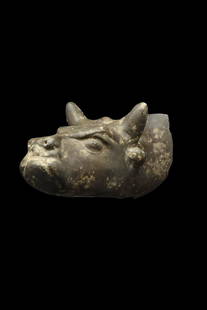
HELLENISTIC POTTERY BULL RHYTON FRAGMENT: Ca. 300-1 BC. A substantial ceramic bull's head from a rhyton with naturalistic features; modelled with short horns, ears, frowning face, eyes, snout and fleshy muzzle. A rhyton is a roughly conical
Est.
£300
-
£600
SOLD
GREEK CYCLADIC ALABASTER JAR: Early Cycladic, Ca. 3000-2800 BC. A carved, bulbous jar having a rounded collar rim and four, carved equidistant small, perforated lugs around the shoulder. For similar vessels see The Museum of
Est.
£3,000
-
£5,000
ETRUSICAN POTTERY BUCCHERO OINOCHOE: Ca. 700-600 BC. An Etruscan bucchero oinochoe in magnificent form with a bulbous base adorned with a register of incised linear lines, sitting on a short flared foot, with flaring rim, pinched large
Est.
£1,500
-
£3,000
Lot Passed
SOLD
RARE APULIAN RED-FIGURE KANTHAROS WITH LADY OF FASHION: Apulian, Ca. 350-300 BC. A rare red-figure kantharos. This tall stemmed cup has two sweeping high handles and a gently flared body that sits on a tiered foot with central fillet. Each side depicts a
Est.
£1,500
-
£3,000
SOLD
MASSIVE GREEK DAUNIAN POTTERY ASKOS: Ca. 400-300 BC. A ceramic askos of an elegant form, this ancient vessel used to pour small quantities of precious liquids such as oil, possessing a characteristic flattened spout and high strap
Est.
£750
-
£1,500
SOLD
GREEK DAUNIAN POTTERY ASKOS: Ca. 400-300 BC. A Daunian askos referred to as a "duck" askos with a globular body with a cylindrical neck, a flaring mouth, and a wide strap handle, decorated with horizontal bands and waves,
Est.
£300
-
£600
SOLD
DAUNIAN POTTERY JAR: Ca. Late 6th/early 5th century BC. A beautiful Daunian jar with a rounded body tapering to a cylindrical neck, an everted tubular rim, and a high looped strap 'horned' handle. The body is decorated
Est.
£300
-
£600
SOLD
ANCIENT GREEK DAUNIAN POTTERY BELL-KRATER: Ca. 400 BC. A finely modelled wheel-thrown bichrome terracotta bell krater of a classic form with a flared rim and twin upraised coil-built handles on a concave raised foot, the body decorated with
Est.
£300
-
£600
SOLD
CANAANITE HOLY LANDS POTTERY JUG: Ca. 1900 BC. A pottery jug with a strap handle, and an amphora-shaped body. Fine red bands encircle the body, and below the neck are displayed a geometrical decoration comprising of parallel lines
Est.
£300
-
£600
SOLD
CYPRIOT TERRACOTTA BICHROME BARREL JUG: Cypro-Geometric, Ca. 1050-700 BC. A barrel jug of cream bichrome painted ware, the spherical body with encircling concentric decoration, with cross-hatched lozenge motifs beneath the handle and on
Est.
£300
-
£600
SOLD
CYPRIOT POTTERY BARREL FLASK: Cypro-Geometric, Ca. 1050-700 BC. Of white painted ware, the spherical body with pronounced nipples and encircling concentric decoration, with cross-hatched lozenge motifs beneath the handle and on
Est.
£300
-
£600
SOLD
CYPRIOT POTTERY MILK BOWL WITH HANDLE: Ca. 1300-1150 BC. A pottery vessel known as a milk bowl displays a tan-coloured ground that is embellished with six groups of vertical linear decorations cascading from a similarly patterned band at
Est.
£300
-
£600
SOLD
CANAANITE HOLY LANDS POTTERY TREFOIL JUG: Ca. 1900 BC. A fine example of a coil-made, pottery jug with a trefoil spout, a strap handle, and an amphora-shaped body. Fine red bands are around the body, below the neck are displayed a
Est.
£300
-
£600
SOLD
ANCIENT MESSAPIAN POTTERY KALATHOS: Ca. 300 BC. A terracotta Messapian Kalathos, the body decorated in with two bands of red painted wreaths, in between two red painted bands. Very fine condition. Paint is in original condition.
Est.
£300
-
£600
GREEK MESSAPIAN POTTERY LEBES GAMIKOS: Ca. 400-300 BC. A Messapian lebes gamikos, a delicately formed "marriage vase" with an inverted bell-shaped body and its characteristic pair of horizontal strap handles set on either shoulder. The
Est.
£450
-
£900
Lot Passed
SOLD
DAUNIAN LEBES GAMIKOS: Ca. 4th century BC. A Daunian lebes gamikos - "marriage vase" with an inverted bell-shaped body and its characteristic pair of horizontal strap handles set on either shoulder. The mouth with a raised
Est.
£450
-
£900
SOLD
GREEK CORINTHIAN ALABASTRON WITH BIRDS: Ca. 600 BC. A beautiful pottery alabastron with a piriform body with a flat disk rim connected by a small loop with a neck. The exterior is adorned with a depiction of two large birds facing each
Est.
£600
-
£1,200
SOLD
GREEK CORINTHIAN ARYBALLOS WITH ANIMALS: Ca. 600-500 BC. A pottery aryballos with its characteristic round body, a short neck, and a rimmed mouth with slightly inward sloping sides. A small handle connects the mouth with the shoulder of the
Est.
£450
-
£900
SOLD
GREEK BLACKWARE ARYBALLOS: Ca. 500 BC. A blackware aryballos with its characteristic round body, a short neck, and a rimmed mouth. A small handle connects the mouth with the shoulder of the vessel. The main body is decorated
Est.
£300
-
£600
SOLD
VILLANOVAN BLACKWARE IMPASTO JAR: Ca. 1100-700 BC. A well-formed blackware jar with twin symmetrical handles rising from the shoulder. The Villanovan culture is known mostly for their cremation burials, which were placed into
Est.
£300
-
£600
SOLD
ETRUSCO-CORINTHIAN KYLIX: Attributable to the Group of the Phoenician Palmettes, Ca. 580 - 560 BC. A terracotta kylix with a hemispherical bowl, short pedestal foot, and two equally spaced loop handles. Decorated in a
Est.
£450
-
£900
SOLD
GREEK BLACKWARE KYLIX WITH PALMETTES: Ca. 400-300 BC. A stemless terracotta Greek kylix (drinking cup), covered in a rich black gloss. The large, shallow body rests on a low foot that concaves, revealing the natural hue of the clay. Two
Est.
£300
-
£600
SOLD
ATTIC BLACKWARE FOOD PLATE: Ca. 400-300 BC. A black-glazed pottery fishplate, having an integral ring foot, wide lower collar rim, and a central circular depression. Two red-brown bands painted on the upper edge border. With an
Est.
£750
-
£1,500
SOLD
GREEK APULIAN RED-FIGURE LEKANIS WITH PALMETTES: Ca. 340-325 BC. A ceramic lekanis of the red-figure lid decorated with palmette designs. The lid's knob handle with radiating strokes on top. The black-glazed dish with an inset flange to receive the
Est.
£150
-
£300
GREEK CAMPANIAN POTTERY BELL KRATER: Ca. 400-300 BC. A magnificent CAMPANIAN terracotta bell krater, executed in black slip. The vessel presents a pedestal base, bell-shaped body, applied handles, and a broad everted rim.Size: L:223mm /
Est.
£600
-
£1,200
Lot Passed
SOLD
GREEK BOEOTIAN BLACK GLAZED KANTHAROS: Ca. 400-300 BC. Greek black-glazed kantharos with high attenuated twin handles and a high stemmed foot with a raised ridge. Lovely hints of iridescence to the black glaze throughout. For a similar
Est.
£450
-
£900
SOLD
GREEK GNATHIAN NET DECORATED POTTERY BOTTLE: Ca. 340-325 BC. A rare bottle created in a pottery workshop in the Apulia region of southern Italy where potters were known for introducing additional pigments to the red-figure painting technique.
Est.
£300
-
£600
GREEK GNATHIAN WARE LEKYTHOS: Ca. 400-300 BC. A fine wheel-thrown pottery lekythos with a low ring foot, a tall ovoid body, a discoid rim with a funnel mouth, and an applied arching handle. Lustrous jet-black glaze covers much of
Est.
£600
-
£1,200
Lot Passed
SOLD
GREEK GNATHIAN TERRACOTTA OINOCHOE WITH DECORATION: Ca. 340-320 BC. An attractive blackware pottery oinchoe with a trefoil spout, decorated in the Gnathian technique with fugitive red, white, and yellow pigments - depicting a lovely grapevine pattern
Est.
£300
-
£600
SOLD
GREEK GNATHIAN BLACKWARE OINOCHOE WITH DECORATION: Southern Italian, Ca.400-300 BC. A Gnathian oinochoe with trilobate spout, constricted neck, piriform body, ring base and L-shaped handle. The exterior is painted black; several registers of painted
Est.
£300
-
£600
SOLD
ANCIENT GREEK GNATHIAN WARE PROCHOUS: Ca. 350-300 BC. A metallic black glazed pottery handled oil bottle having a tapered bulbous body, high angular handle, and pour spout, stylized lion head lugs at the sides of the channel spout.
Est.
£450
-
£900
SOLD
ANCIENT GREEK GNATHIAN EPICHYSIS: Apulia, Southern Italy, Ca. 375–300 BC. A Gnathian-ware epichysis decorated with tongues on the neck, dots, zigzags and berried laurel band on the shoulder. The body displays a meander
Est.
£750
-
£1,500
SOLD
A GREEK GNATHIAN PROCHOUS WITH LION HEAD TERMINALS: Ca. 400 BC. A delicate, well detailed vessel known as a prochous, formed in a black-glazed, crafted with a tall bulbous body tapering into shaped spout and long handle behind. Elegantly decorated
Est.
£1,000
-
£2,000
SOLD
GREEK GNATHIAN POTTERY PROCHOUS: Ca. 4th century BC. A pouring vessel known as a prochous, wheel-thrown and decorated with a lustrous black glaze. The vessel is defined by its discoid foot, a bulbous teardrop-shaped body, a narrow
Est.
£300
-
£600
SOLD
GREEK GNATHIAN SKYPHOS WITH IVY AND VINE TENDRILS: Ca. 2nd half of the 4th - 1st half of the 3rd Century BC. A particularly nice and well-preserved example of a typical drinking cup from Southern Italy in the highly decorative Gnathian style.
Est.
£150
-
£300
SOLD
GREEK GNATHIAN BLACK-GLAZED POTTERY TWO-HANDLED CUP: Ca. 350 BC. A black glazed pottery pedestal cup, having a large loop, opposing handles with flat wide thumb rests. Lower tapered bulbous rim with a fluted edge. Simple white-painted stylized vine.
Est.
£300
-
£600
SOLD
ANCIENT GREEK GUTTOS REPRESENTING ZEUS-AMMON: Ca. 3rd century BC. Black glazed terracotta guttos on a small foot with a very wide and short body. On one side of the body, a long and thin spout extends upwards, finishing in an everted rim. On the
Est.
£150
-
£300
SOLD
ANCIENT GREEK GLAZED GUTTOS WITH GORGONEION HEAD: Ca. 360-320 BC. A black-glazed terracotta guttos (oil-lamp filler) with a spool-shaped foot, a wheel-shaped body, a protruding ring handle, and a cylindrical spout with an everted rim. The tondo
Est.
£150
-
£300
SOLD
GREEK APULIAN BLACK GLAZED DUCK ASKOS: Ca. 340-325 BC. A pottery askos presenting in the form of a 'duck' with a tiered foot, a bulbous body with a concave top, a petite strap handle, a projecting funnel-form mouth, and a perky tail on
Est.
£300
-
£600
SOLD
DAUNIAN BLACK GLAZED DUCK ASKOS: Ca. 340-325 BC. A pottery askos presenting in the form of a 'duck' with a tiered foot, a bulbous body with a concave top, a petite strap handle, a projecting funnel-form mouth, and a perky tail on
Est.
£300
-
£600
SOLD
PALAEO-MYCENAEAN PYXIS: Late Bronze Age, Ca.1300 BC. A pyxis in buff terracotta; twin lug handles on the shoulders for suspension (suspension would help in evaporation of the liquid and aid cooling), a funnelled neck and
Est.
£450
-
£900
SOLD
CYPRIOT POTTERY BICHROME JUGLET: Cypro-Geometric Period, Ca. 1050-700 BC. A decorated pottery juglet with painted salmon color wide band and dark brown painted concentric ring elements. Elegant rounded flared lips and an ear type
Est.
£300
-
£600
SOLD
HERODIAN GREEN GLAZED OINOCHOE: Judea, Ca. 37 BC-70 AD. The body of this juglet is piriform and a small ridge is present just below the cylindrical neck. The rim is thick and everted with a single, arching handle attached form the
Est.
£300
-
£600
SOLD
ANCIENT GREEK BRONZE MIRROR WITH HORSE: Ca. 5th-4th century BC. A bronze Graeco-Scythian type mirror featuring a circular face which was originally the reflective surface, a handle shaped like a fluted column and a standing horse to the
Est.
£1,500
-
£3,000
SOLD
ROMAN LEAD VOTIVE MIRROR WITH DECORATION: Ca. 100-300 AD. A beautiful lead votive mirror, with a circular disk and rectangular handle with scroll-shaped supports. The obverse is covered with several concentric registers of moulded
Est.
£150
-
£300
SOLD
ROMAN LEAD VOTIVE MIRROR WITH DECORATION: Ca. 100-300 AD. A lead votive mirror, with a circular disk and a flat, rectangular handle with small lateral supports. The obverse is covered with moulded pelta-shaped decoration, arranged around a
Est.
£150
-
£300
SOLD
MASSIVE ROMAN BRONZE CHARIOT APOLLO FITTING: Ca. 100-300 AD. A massive cast-bronze fitting coming from a chariot depicting a male figure with youthful features (possibly the god Apollo, the Roman and Greek god of music and dance). He wears
Est.
£750
-
£1,500
SOLD
ROMAN BRONZE HYDRIA ATTACHMENT OF A SIREN: Ca. 100-300 AD. Large cast bronze hydria attachment depicting the bust of a siren having a fancy hairdo, expressive facial features, wearing a belted chest plate, and surrounded with a multi-leaf
Est.
£450
-
£900
SOLD
MASSIVE ANCIENT ROMAN BRONZE LION HEAD DOOR KNOCK: Ca. 200-300 AD. A bronze door knock shaped as a lion head handle cast in high relief within a circular border. The animal's head modelled with a prominent browline and eyes, a ring in its gaping jaw.
Est.
£3,000
-
£6,000
SOLD
ROMAN BRONZE LION PROTOME - EX. BONHAM'S: Ca. 1st–2nd century AD. A superbly cast lion protome with the rich full mane of overlapping wavy locks, the lion's mouth open wide, the muzzle naturalistically rendered, the deep-set lidded
Est.
£400
-
£600
SUPERB ROMAN BRONZE OLPE - GREAT PATINA: Ca. 100-300 AD. A bronze olpe rising from a ring foot. The vessel features a globular lower body tapering to a gracefully-shaped neck and ending with a flared rim. A small looped handle connects the
Est.
£1,500
-
£3,000
Lot Passed
SOLD
RARE ROMAN BRONZE CUPID DIE FOR CASTING MOUNTS: Ca. 100-300 AD. A bronze die for casting mounts in the form of a bust of Cupid (Greek Eros) with fleshy features and curly hair. His chubby cheeks portray the features of youth, his stylised wings
Est.
£150
-
£300
SOLD
ROMAN BRONZE EROS HOLDING A PATERA: Ca. 100-300 AD. A bronze figurine of a young Eros, depicted in a standing pose, naked. He is striding forward with his left leg advanced, his right arm stretched holding a patera. His eyes
Est.
£300
-
£600
SOLD
ROMAN BRONZE VENUS FIGURINE: Ca. 1-200 AD. A cast bronze statuette of goddess Venus standing with her weight on her right leg, the left leg bent at the knee and slightly advanced, leaning into her right hip, her slender torso
Est.
£300
-
£600
SOLD
ROMAN BRONZE PRIAPUS FIGURE: Ca. 100-300 AD. A free-standing bronze statuette of the god Priapus shown with a long beard, standing with erect phallus and a pile of fruit, symbolizing his influence over fertility and abundance.
Est.
£150
-
£300
SOLD
ROMAN BRONZE LION HEAD PHALLERA: Ca. 100-200 AD. A cast bronze phalera formed as a lion's mask. The animal's head with prominent brow and eyes, an open mouth, and a detailed mane framing the face. This was likely to have been worn
Est.
£150
-
£300
SOLD
ROMAN BRONZE LEGIONARY EAGLE FIGURINE: Ca. 100-200 AD. A cast bronze figurine of an eagle perching on an integral stand. Expertly cleaned and conserved, with a smooth patina. An aquila (eagle) was a prominent symbol used in ancient Rome,
Est.
£300
-
£600
SOLD
ROMAN BRONZE EAGLE FIGURINE: Ca. 100 AD. A realistically modelled bronze eagle figurine, standing on a base, long wings folded, the wingtips crossed, feather detailing to the body and wings. An aquila (eagle) was a prominent
Est.
£300
-
£600
SOLD
ROMAN BRONZE PANTHER BROOCH: Ca. 100-200 AD. A beautiful bronze panther brooch with a slender, stretched body with recessed circles to accept enamel inlays. Catchplate to the reverse. In ancient Greek mythology, the panther was
Est.
£150
-
£300
SOLD
ANCIENT GREEK HOPLITE SOCKETED BRONZE SPEAR: Ca. 800-600 BC. A socketed bronze spearhead comprising a substantial lentoid-section blade with raised midrib, and a long shaft. Hoplites were the citizen-soldiers of Ancient Greece, where each city
Est.
£200
-
£300
SOLD
ANCIENT ROMAN BRONZE SURGICAL INSTRUMENTARIUM: Ca. 100-300 AD. A rare set of five Roman surgical tools composed of a double-ended fork, spoon, spatula, and probes. Each tool with a long, round section shaft, one twisted. Professionally mounted on
Est.
£200
-
£300
ROMAN SILVER COCHLEAR SPOON: Ca. 100-300 AD. A solid silver spoon with a wide bowl attached to a long round-section handle finished with a pointed finial for use in extracting snails from their shells. For a similar example, see
Est.
£1,500
-
£3,000
Lot Passed
SOLD
ROMAN SILVER BOWL: Ca, 100-300 AD. An outstanding silver bowl with a slightly rounded base, straight rim and a broad, deep body. Bowls of this kind were used for pouring libations to the gods and for drinking on more
Est.
£450
-
£900
SOLD
ROMAN SILVER BOWL: Ca, 100-300 AD. A silver wine bowl with a hemispherical body and smooth walls. Banqueting was a major part of the aristocratic culture in antiquity and required a range of specialised utensils and
Est.
£450
-
£900
BRONZE AGE HALLSTATT BRONZE DECORATED VESSEL: Ca. 1200-800 BC. A hammered-bronze vessel of a wide, circular form with its walls gently tapering to a flat base. The mid-section is adorned with a triple register of raised bosses. To one side a
Est.
£1,500
-
£3,000
Lot Passed
SOLD
ANCIENT ROMAN TERRA SIGILLATA PLATE WITH DECORATION: Ca. 300-400 AD. A wheel-thrown redware pottery dish of a squat form that rests atop a flat base. The vessel features broad walls, a shallow basin, and two grooves between the rim and basin. The
Est.
£300
-
£500
SOLD
ANCIENT ROMAN TERRA SIGILLATA PLATE WITH DECORATION: Ca. 300-400 AD. A large terracotta shallow plate or dish with its walls gently tapering to a low ring base. Between the rim and basin, there is a deep groove, probably to accommodate a lid. 'Terra
Est.
£300
-
£500
NORTH AFRICAN TERRA SIGILLATA BOTTLE: Ca. 300-400 AD. A fine redware jug, with a rounded body and applied decoration including a youthful Bacchus drinking from a wine cup, and four palm fronds. The top of the neck is decorated with two
Est.
£750
-
£1,500
Lot Passed
SOLD
NABATAEAN TERRACOTTA PERFUME BOTTLE: Ca. 100-200 AD. A finelly modelled red terracotta perfume bottle, featuring a long, cylindrical body, tapering into a deep-set mouth and overturned rim. An applied handle stretches from the
Est.
£400
-
£600
RARE ROMAN POTTERY SKYPHOS: Ca. 100 BC - 100 AD. The mold-made body is decorated with a pine-cone or petal-like motif, with a smooth foot, rim, and the ribbed ring handles each with moulded thumb-piece. For a similar glazed
Est.
£450
-
£900
Lot Passed
ROMAN GALLO POTTERY BOWL: Ca. 100-300 AD. A red pottery bowl in globular form decorated with a moulded barbotine scale pattern, standing on a small pedestal foot. For a similar styles see The Metropolitan Museum of Art
Est.
£300
-
£600
Lot Passed
SOLD
ROMAN TERRACOTTA OIL LAMP WITH GLADIATOR: Ca. 100-300 AD. A mould-made terracotta oil lamp with concave discus bearing a relief image of a defeated gladiator facing right. He is depicted in a seated position, he wears a helmet and holds a
Est.
£450
-
£900
SOLD
ROMAN TERRACOTTA OIL LAMP: Ca. 100-200 AD. A figural terracotta oil lamp with a single handle. The discus is framed by two concentric rings, in the middle is a frontal portrait with a high headgear and horns. The maker's mark
Est.
£150
-
£300
SOLD
ROMAN TERRACOTTA OIL LAMP WITH HERON: Ca. 100-200 AD. A mould-made terracotta oil lamp with concave discus bearing a relief image of a standing heron facing left. The shoulder of the lamp is flat, with a deep groove circle framing the
Est.
£150
-
£300
SATYR/PRIAPUS TERRACOTTA LAMP: Ca. 1st-4th century AD. A Roman oil lamp taking the form of a Satyr or, perhaps, the deity Priapus. Mould-made, this lamp presents an intricate and unusual form, with a large grotesque face capturing
Est.
£450
-
£900
Lot Passed
ROMAN GLASS PLATE: Ca. 50-200 AD. A beautiful light green, blown glass dish with a rounded lip on a low round foot. Strabo (Geography 16.2.25) tells us that the Romans in the early Imperial period (1st century AD) were
Est.
£750
-
£1,500
Lot Passed
SOLD
HUGE ROMAN PALE GREEN GLASS BOTTLE: Ca. 100-300 AD. A beautiful bottle formed in translucent green glass, the body globular with a slightly outsplayed vertical rim, with a hollow horizontal flange below, made by folding slender
Est.
£1,500
-
£3,000
LARGE ROMAN GLASS FLASK: Ca. 100-200 AD. A large heavy blown glass flask with a globular body, long tubular neck, and flat base, with wheel cut banding over the entire body and neck, with a rolled rim. The straight
Est.
£750
-
£1,500
Lot Passed
SOLD
ANCIENT ROMAN GLASS FLASK: Ca. 200-300 AD. An elaborately modelled glass flask in light green with long everted neck and bulbous shaped body, the neck has a wheel made trailing decoration which has been applied afterwards. For
Est.
£750
-
£1,500
SOLD
AQUAMARINE ROMAN PINCHED GLASS FLASK: Ca. 100–200 AD. A free-blown sprinkler flask of transparent aquamarine glass featuring a cylindrical flaring neck and a funnel-shaped mouth. The globular body is decorated with small, pinched
Est.
£750
-
£1,500
ANCIENT ROMAN GLASS AMPHORISKOS: Ca. 100-300 AD. A rare glass amphora or amphoriskos with flaring rim, tapering neck, flaring shoulder and truncated conical body; two fine strap handles are applied to the rim and the shoulder; much
Est.
£300
-
£600
Lot Passed
SOLD
ROMAN GLASS UNGUENTARIUM: Ca. 1st-3rd century AD. An amphora shaped vessel with an ovoid body with a strand of glass pulled out at the bottom to form a tip and a tall tubular neck. The weathering crust that has formed over
Est.
£300
-
£600
SOLD
ROMAN GLASS ALABASTRON: Ca. 300-400 AD. A beautiful cylindrical, multicolour (black, blue, white, green) alabastron tapering towards the mouth. Alabastra were an ancient form of vessel, used to contain cosmetics, oils and
Est.
£300
-
£600
ANCIENT ROMAN GLASS DOUBLE BALSAMARIUM: Ca. 300-400 AD. A finely modelled double balsamarium in dark green glass; The vessel is composed of two conjoined tubular phials with slightly flared and thickened rims. This vessel would originally
Est.
£600
-
£900
Lot Passed
ANCIENT ROMAN GLASS DOUBLE BALSAMARIUM: Ca. 300-400 AD. A finely modelled double Balsamarium in pale green glass. The vessel is composed of two conjoined tubular phials with slightly flared and thickened rims. For a similar see Roman Glass
Est.
£300
-
£600
Lot Passed
ROMAN GLASS COSMETIC CONTAINER: Ca. 200-400 AD. A fine Ancient Roman cosmetic container blown from pale green glass with nice purple silver iridescence evident. The vessel features a slender piriform body with trailing ribbed
Est.
£300
-
£600
Lot Passed
SOLD
ROMAN GLASS UNGUENTARIUM: Ca. 4th–5th century AD. A glass unguentarium with a piriform body standing on an applied disc base featuring an everted mouth and applied handles that join the shoulder to the rim. The
Est.
£300
-
£600
SOLD
ROMAN GLASS DOUBLE UNGUENTARIUM: Ca. 200–300 AD. A double-tube glass balsamarium with decorative applied trails around both rims and bodies in a green-clue tinge. It displays patches of thick milky weathering and brilliant
Est.
£300
-
£600
ROMAN GLASS DOUBLE UNGUENTARIUM: Ca. 200-300 AD. A double-tube glass balsamarium with decorative applied trails around both rims and bodies in a green-clue tinge. It displays patches of thick milky weathering and brilliant
Est.
£300
-
£600
Lot Passed
ROMAN GLASS DOUBLE UNGUENTARIUM: Ca. 200-300 AD. A double-tube glass balsamarium with decorative applied trails around both rims and bodies in a green-clue tinge. It displays patches of thick milky weathering and brilliant
Est.
£300
-
£600
Lot Passed
SOLD
UNUSUAL ROMAN GLASS FLASK: Ca. 1st-3rd century AD. Blown glass flask with a roughly cuboid body and an elongated neck that flares outwards towards the top. Deep green-brown hue. Roman glass expanded upon Hellenistic techniques
Est.
£300
-
£600
SOLD
SMALL ROMAN GLASS JAR WITH HANDLES: Ca. 300 AD. A beautiful translucent green jar with bulbous body, handles in same colour, an outsplayed rim, folded over and in, and smoothed into the side of the mouth, a broad funnel-shaped neck, a
Est.
£300
-
£600
SOLD
ANCIENT ROMAN OR BYZANTINE GLASS RIBBED FLASK: Ca. 400-500 AD. A well blown ancient Roman greenish blue glass flask, featuring a bulbous globular body, cylindrical neck, and wide rim. Very fine condition. Intact. For a similar see Roman Glass in
Est.
£300
-
£600
SOLD
ROMAN GLASS FLASK: Ca. 100-300 AD. A glass flask with a spherical body, a short funnel-shaped neck and a wide, flanged profile mouth. Some weathering and incrustation occur throughout the flask; the outside shows a
Est.
£150
-
£300
SOLD
HELLENISTIC GOLD RING WITH GARNET: Ca. 400-200 BC. A gold finger ring composed of a round hoop with hunched shoulders and an integral bezel cell with garnet cabochon inset. Excellent condition, wearable.Size: D: 17.12mm / US: 6 3/4 /
Est.
£600
-
£900
SOLD
HELLENISTIC GOLD BRACELET WITH KNOT CLASP: Hellenistic, Ca. 200-1 BC. Hellenistic, Ca. 200-1 BCA gold wire bracelet with a round-section shank, knot clasp, and coiling around each terminal. Absolutely could be worn but rather as a slip-on
Est.
£750
-
£1,500
SOLD
ROMAN GOLD EARRINGS WITH GRANULATION: Ca. 100-300 AD. A substantial set of Ancient Roman gold earrings featuring a large convex shaped bead which looks like a vessel, with a beautiful pendant decorated with fine granulation on its rim;
Est.
£1,500
-
£3,000
GREEK RIBBON-BAND GLASS BEAD NECKLACE: Ca. 100 BC - 300 AD. A beautiful necklace comprising biconical and barrel-shaped beads, interspersed with spool-shaped gold beads. For a comparison see Christie's, lot 154, Oct 1, 2014. For a similar
Est.
£3,500
-
£6,000
Lot Passed
SOLD
HELLENISTIC GOLD AND LAPIS LAZULI NECKLACE: Ca. 400 BC. A restrung necklace comprising lapis lazuli beads, interspersed with biconical and spherical gold beads. Necklaces were part of the feminine costume in the Hellenistic world and were used
Est.
£600
-
£900
SOLD
HELLENISTIC GOLD AND CARNELIAN NECKLACE: Ca. 400 BC. A restrung necklace comprising large carnelian beads, interspersed with small lapis lazuli and gold beads. Necklaces were part of the feminine costume in the Hellenistic world and were
Est.
£600
-
£900
SOLD
HELLENISTIC GOLD AND GLASS NECKLACE: Ca. 400 BC. A restrung necklace comprising variously shaped glass beads, interspersed with gold beads and pendants. Necklaces were part of the feminine costume in the Hellenistic world and were used
Est.
£600
-
£900
SOLD
HELLENISTIC GOLD AND CARNELIAN LARGE NECKLACE: Ca. 400-300 BC. A beautiful necklace composed of variously shaped carnelian and gold beads arranged in a symmetrical manner. Restrung on a modern thread and suitable for contemporary wear. Necklaces
Est.
£600
-
£900
SOLD
HELLENISTIC CRYSTAL, GARNET, AND GOLD NECKLACE: Hellenistic, Ca. 300-200 BC. Hellenistic, Ca. 300-200 BCA beautiful necklace made of raw crystal and garnet beads spaced with high karat, barrel-shaped, fluted yellow gold beads.Size: L:248mm /
Est.
£600
-
£1,200
SOLD
ANCIENT ROMAN GLASS AND GOLD NECKLACE: Ancient Roman, Ca. 1-100 AD. Ancient Roman, Ca. 1-100 ADA petite necklace of small glass and yellow gold beads. The necklace has been strung in vaguely graduated sizes. But the final 8 glass beads at
Est.
£600
-
£1,200
SOLD
GREEK HELLENISTIC GOLD PENDANT WITH DOLPHINS: Ca. 300 BC. An amphora-shaped pendant of a central wired shaft threaded with a piriform coral stone secured at the bottom with a small bead. To the top, a suspension ring, flanked by a pair of
Est.
£300
-
£600
SOLD
HELLENISTIC GOLD PENDANT WITH GARNET STONE: Ca. 500-300 BC. A gold circular pendant with concentric filigree decoration flanking a central large garnet cabochon. The reverse is flat and unworked. Restrung on a modern thread and suitable for
Est.
£750
-
£1,500
SOLD
ROMAN SILVER AND GOLD INTAGLIO RING WITH SERAPIS: Ca. 1-100 AD. A bronze ring with a round hoop widening at the shoulders and set with a gilded bezel cell bearing a carnelian intaglio engraved with a bust of a bearded Serapis, a syncretic deity of
Est.
£750
-
£1,500
SOLD
ROMAN BRONZE RING WITH PENTAGRAM: Ca. 1-200 AD. A bronze ring with a round hoop with incised decoration on the shoulders, and flattened, circular bezel bearing a pentagram within a circle. For more information on Roman rings, see:
Est.
£150
-
£300
SOLD
ROMAN BRONZE RING WITH X PATTERN: Ca. 200 AD. A cast bronze legionary ring with round hoop and an integral bezel engraved with 'X' pattern, representing number 10 in Latin, possibly standing for the 10th Legion. Very well preserved,
Est.
£150
-
£300
SOLD
ANCIENT ROMAN SILVER BRACELET: Ca. 100-300 AD. A fine open-type bracelet composed of a silver band with its ends embellished with small notches. A beautiful and wearable piece of fine Roman jewelry!Size: L:67mm / W:68.7mm ;
Est.
£150
-
£300
SOLD
ANCIENT ROMAN SILVER BRACELET: Ca. 100-300 AD. An elegant, penannular bracelet made of silver. The body is smooth, round-section, with incised designs around its terminals. A beautiful and wearable piece of fine Roman
Est.
£200
-
£400
SOLD
ROMAN BRONZE DISK BROOCH: Ca. 100-200 AD. A bronze disk brooch with openwork decoration forming abstract geometric patterns and a well-preserved pin and catch-plate on the reverse. Brooches were an important element of Roman
Est.
£150
-
£300
SOLD
ROMAN BRONZE OPENWORK "ROMA" BROOCH: Ca. 100-300 AD. A bronze disk brooch with openwork decoration forming ROMA inscription. Catch-plate with a pin on the reverse. Brooches were an important element of the Roman dress, used to fasten
Est.
£150
-
£300
SOLD
ROMAN MOSAIC DISC BROOCH: Ca. 300 AD. A beautiful flat circular broach featuring a central raised boss and a concentric ring decoration inlaid with coloured enamelling in a green, red, and light blue palette; two circular
Est.
£300
-
£600
SOLD
ROMAN MILLEFIORI DISC BROOCH: Ca. 300 AD. A beautiful esagonal broach featuring small decorative peripheral lugs with coiled decoration, the rim decorated with an hatched pattern, and a recessed central ring encased by a blue
Est.
£300
-
£600
ROMAN BRONZE FLY / CICADA BROOCH: Ca. 100-200 AD. Bronze brooch in the form of a fly or cicada, with broad, curving wings and stylised head. The catch plate and hinge are still present on the reverse. Zoomorphic brooches were common
Est.
£150
-
£300
Lot Passed
SOLD
ROMAN SILVER ANCHOR-HEADED FIBULA: Ca. 100 AD. A silver fibula brooch with an anchor-shaped body decorated with spheres to each finial. Spring mechanism with a pin and a catch plate to the back. Good condition, a rare type. Brooches
Est.
£150
-
£300
SOLD
ROMAN BRONZE "WHEEL OF FORTUNE" BROOCH: Ca. 200-300 AD. A bronze open work plate brooch in the shape of a wheel, also known as a "Wheel of Fortune", depicting the Sun symbol in the centre. Good Condition. Cf. Richard Hattatt (2000), A
Est.
£150
-
£300
SOLD
ROMAN BRONZE SWASTIKA BROOCH WITH HORSE HEADS: Ca. 100-300 AD. A bronze brooch in a form of a swastika with four stylised horse head terminals, and a catch-plate on the reverse. The swastika was a symbol of lightning bolts in Roman art and is
Est.
£150
-
£300
SOLD
ROMAN BRONZE SWASTIKA BROOCH: Ca. 100-300 AD. A bronze openwork swastika brooch with a catchplate on the reverse. The swastika was a symbol of lightning bolts in Roman art and is therefore associated with the thunder god,
Est.
£150
-
£300
SOLD
ROMAN BRONZE S-SHAPED BROOCH: Ca. 100-300 AD. A bronze S-shaped brooch with a catch plate on the reverse. Good condition. This object conveys the pervasiveness of a Celtic aesthetic in the Empire's western provinces in the first
Est.
£150
-
£300
SOLD
ROMAN BRONZE AXE-SHAPED BROOCH: Ca. 200-300 AD. An axe-shaped brooch with an asymmetric blade stretching downwards. This brooch type is typical of central European productions under the Roman Empire, probably reflecting the martial
Est.
£150
-
£300
SOLD
ROMAN BRONZE HORSE BROOCH: Ca. 100-300 AD. A nice bronze plate brooch of a grazing horse on a baseline. The animal is modelled in the half-round with a looped tail. Catch plate to the reverse. Good condition. For comparable
Est.
£150
-
£300
SOLD
ROMAN BRONZE HERM PENDANT: Ca. 1-300 AD. A bronze herm pendant of a quadrangular post narrowing downwards, and at the top ending with a bust of a man with his hair swept back and a large loop protruding from the top of his
Est.
£150
-
£300
SOLD
COLLECTION OF FOUR ROMAN GLASS BRACELETS: Ca. 100-300 AD. Four Roman glass bracelets of various sizes in a green, black, and blue palette. In contrast with the paucity of black glass vessels, a wide range of dark-coloured glass jewellery is
Est.
£150
-
£300
SOLD
ANCIENT ROMAN GROUP OF FIVE GLASS BANGLES: Late Roman, Ca. 300-500 AD. A group of five glass bracelets (also referred to as bangles) comprising monochrome glass strains bent into a loop. Colours in this group include: 1) black, 2) blue. Glass
Est.
£150
-
£300
SOLD
ROMAN CARNELIAN INTAGLIO WITH LEDA AND SWAN IN GOLD RING: Ca. 200 AD. A carnelian intaglio engraved with a scene of Leda and the Swan set in a possibly later gold ring. Leda, a princess from Aetolia, who would later become the queen of Sparta, was carried
Est.
£1,500
-
£3,000
SOLD
ROMAN GRYLLOS INTAGLIO GOLD RING: Ca. 100 AD. A gold finger ring composed of a slender round hoop with an applied bezel cell set with a stone intaglio engraved with gryllos - a grotesque combination. A creature consists of a
Est.
£750
-
£1,500
SOLD
ROMAN GOLD RING WITH CUPID STONE INTAGLIO: Ca. 100-200 AD. A gold finger ring of a thin hoop with fine granules to each shoulder. The bezel centred by an intaglio depicting a figural representation of Cupid facing left. In Roman mythology,
Est.
£450
-
£900
SOLD
ROMAN GOLD RING WITH VENUS STONE INTAGLIO: Ca. 100-300 AD. A beautiful gold finger ring with a circular hoop and a slender bezel set with a stone intaglio engraved with a depiction of partially robed Venus, turned left. The ancient Roman
Est.
£750
-
£1,500
SOLD
ROMAN GOLD RING WITH ROCK CRYSTAL INTAGLIO: Ca. 100-300 AD. A gold finger ring composed of a slender round hoop expanding to form a circular bezel set with a rock crystal gem engraved with a with a portrait of a young male facing left. Good
Est.
£450
-
£900
SOLD
ROMAN GOLD RING WITH INSCRIBED CARNELIAN INTAGLIO: Ca. 300-400 AD. A D-shaped gold finger ring of a flat-section hoop with nicely sculpted shoulders forming a bezel set with and a garnet gemstone inscribed possibly with Christian monogram. Size:
Est.
£750
-
£1,500
SOLD
ANCIENT ROMAN STANDING VENUS INTAGLIO IN GOLD RING: Ca. 100-300 AD. An oval-shaped carnelian intaglio with an engraved depiction of the standing goddess Venus with her both hands raised, set in a spectacular gold ring of a possibly later period, with
Est.
£1,000
-
£1,500
SOLD
ROMAN GOLD RING WITH CLASSPED HANDS INATGLIO: Ca. 1-300 AD. A gold ring with a circular hoop, pairs of fine granules on the shoulders, and an oval-shaped intaglio with a 'dextrarum iunctio' ('joining together of the right hands') motif. In the
Est.
£600
-
£1,200
SOLD
ROMAN CAMEO WITH JULIA DOMNA IN GOLD RING: Ca. 200 AD. A beautiful cameo depicting a bust of Julia Domna, the Roman empress from 193 to 211 as the wife of Emperor Septimius Severus. She is portrayed in her left profile with delicate face
Est.
£1,500
-
£3,000
SOLD
ROMAN GOLD RING WITH LARGE EMERALD GEM: Ca. 100-300 AD. A beautiful gold finger ring formed of a band slightly rounded on the outside and flat to the inside, and an applied large bezel set with an emerald gemstone. Gemstone restored. Size:
Est.
£750
-
£1,500
SOLD
ANCIENT ROMAN GOLD RING WITH PALM BRANCH: Ca. 100-200 AD. A simple yet elegant gold finger ring of a circular, slender hoop expanding to a flat bezel engraved with a palm branch oriented horizontally. Each offshoot of the branch terminates
Est.
£300
-
£600
SOLD
LATE ROMAN GOLD RING WITH CHI-RHO SYMBOL: Ca. 300-400 AD. An elegant gold hoop with an attached circular plate bezel flanked by spherical baubles. The bezel features an incised Chi-Rho motif. This symbol, which derives its name from the
Est.
£1,500
-
£3,000
SOLD
ROMAN GOLD EARRINGS WITH GRANULATION: Ca. 100-300 AD. A substantial pair of Ancient Roman gold earrings featuring a large convex shaped bead which looks like a vessel, with a beautiful pendant decorated with fine granulation on its rim;
Est.
£1,500
-
£3,000
SOLD
ROMAN GOLD CAMEO EARRINGS: Ca. 1st-5th century AD. Pair of cameos depicting Medusa facing forward, set into gold earring bezzels with the suspension loop above and a stout gold trapezium below with three strands of colourful
Est.
£1,500
-
£3,000
SOLD
ROMAN GOLD EARRINGS WITH GLASS BEADS: Ca. 1-300 AD. A pair of gold hoop earrings comprising medium hoops, each with three strands of glass and gold beads. These beautiful pieces probably belonged to a Roman noblewoman. Excellent
Est.
£750
-
£1,500
ROMAN MATCHED PAIR OF GOLD EARRINGS: Ca. 100-300 AD. 22K Gold Earrings. Openwork design bearing cabochon garnets in a triangular pattern. Excellent condition and wearable. Size: L:30mm; 5.8gProvenance: From the property of an East Coast
Est.
£750
-
£1,500
Lot Passed
SOLD
PAIR OF ROMAN GOLD EARRINGS: Ca. 100 AD. A matched pair of rare gold pendants shaped as a bird’s claw. The surface of each gold pendant is decorated with a fine granulated pattern. The three endings of each pendant
Est.
£750
-
£1,500
ROMAN GLASS IN 22K GOLD FILIGREE PENDANT: Ca. 100-200 AD. An oval-shaped highly patinated Roman glass, set in possibly later 22k gold pendant with an elegant filigree border; an integral suspension loop bearing a filigree diamond design. For
Est.
£750
-
£1,500
Lot Passed
SOLD
ROMAN PENDANT IN THE SHAPE OF HERCULES’ CLUB: Ca. 100-200 AD. A hollow-formed gold pendant shaped like a tapering cylinder with applied filigree detailing and small gold dots; there is an integral loop on top whilst the bottom is a small gold
Est.
£600
-
£900
SOLD
ALEXANDER THE GREAT SILVER DRACHM COIN PENDANT: Ca. 295-275 BC. A silver coin / drachm of Alexander the Great within a modern handmade circular sterling silver setting. The coin shows on the obverse the head of young Herakles facing right and
Est.
£150
-
£300
SOLD
ALEXANDER THE GREAT SILVER TETRADRACHM COIN PENDANT: Ca. 295-275 BC. A silver coin / tetradrachm of Alexander the Great within a modern handmade circular sterling silver setting. The coin shows on the obverse the head of young Herakles facing right and
Est.
£150
-
£300
SOLD
CELTIC IRON AGE SILVER NECKLACE WITH PHALLIC PENDANTS: Ca. 100 BC - 100 AD. Large and rare silver necklace made of several twisted rods held together by rings, three phallic pendants are attached to the centre. Celtic society, like all patriarchal
Est.
£1,500
-
£3,000
MASSIVE BRONZE AGE ARM RINGS / BRACELETS: Ca. 1000-600 BC. A pair of thick and heavy cast bronze bracelets or arm rings with circular sections and square, recurved terminals with incised decoration. In the Bronze Age bracelets and arm rings
Est.
£1,500
-
£3,000
Lot Passed
SOLD
CELTIC LA TENE BRONZE PAIR OF BROOCHES: Ca. 300 BC. An interesting pair of La Tène I type bow brooches, each with a deep bow, pin to reverse, and a foot with a lateral catch. The La Tène culture is a predominantly Celtic culture
Est.
£150
-
£300
SOLD
CELTIC LA TENE BRONZE PAIR OF BROOCHES: Ca. 300 BC. A pair of La Tène I type bow brooches, each with a deep bow, sprung head, and a pin to reverse. The La Tène culture is a predominantly Celtic culture belonging to the Iron Age, also
Est.
£150
-
£300
CELTIC LA TENE BRONZE PAIR OF BROOCHES: Ca. 300 BC. A pair of La Tène I type bow brooches, each with a deep bow, sprung head, and a pin to reverse. The La Tène culture is a predominantly Celtic culture belonging to the Iron Age, also
Est.
£150
-
£300
Lot Passed
SOLD
STUNNING CELTIC BRONZE AGE SOCKETED SPEAR: Ca. 1000-800 BC. A stunning large bronze spearhead with a leaf-shaped blade, prominent midrib, conical shoulder decorated with five horizontal ribs, terminating in a circular socket. This spear is a
Est.
£750
-
£1,500
PUBLISHED CRUSADERS IRON PROCESSIONAL CROSS: Ca. 1100-1400 AD. An exquisite cast copper-iron processional cross composed of two flared sections pinned together in the center with a cast-bronze medallion. The lateral arms have pointed finials on
Est.
£7,500
-
£15,000
Lot Passed
MEROVINGIAN IRON SWORD WITH GOLD AND GARNETS: Ca. 600 AD. A long Migration period iron sword with rare patterned Damascus steel blade, comprising a lentoid-section parallel-sided blade with a broad tapering tip. A rectangular lower guard of
Est.
£25,000
-
£45,000
Lot Passed
SOLD
MEDIEVAL IRON CRUSADERS SWORD - FULL REPORT: Ca. 1350 AD. This late Medieval sword comprises of a long slender triangular blade with a fuller, three quarters of its length and an undamaged tang. The cross guard and pommel are replete and
Est.
£3,000
-
£6,000
RARE 15th C. EPEE IRON SWORD WITH REPORT: Ca. 1330-1450 AD. This sword is the epitome of épées, a truly magnificent example. The pommel is very elegant and appropriately called a ‘scent bottle stopper’, probably due to the
Est.
£6,000
-
£12,000
Lot Passed
SOLD
LATE MEDIEVAL IRON SWORD WITH REPORT: Ca. 1400-1450 AD. This is an excellent and somewhat complete sword from the late Medieval period. The pommel is a circular disc, with a raised circular collar on each face. The condition is excellent
Est.
£4,500
-
£9,000
MEDIEVAL IRON SWORD WITH REPORT: Ca. 1250-1520 AD. This fine Medieval sowrd features a pommel of an unusual design. It is circular when viewed from the front and sides, but displays a thick cross-like section when viewed from above.
Est.
£4,500
-
£9,000
Lot Passed
SOLD
VIKING IRON SWORD - FULL REPORT: Ca. 10th Century AD. This sword of the Viking era is largely intact, with the pommel, lower cross guard, blade, and tang all complete. The surface overall is pitted, and the sword blade edges have
Est.
£3,000
-
£6,000
VIKING IRON SWORD - FULL REPORT: Ca. 10th Century AD. A wonderful example of a Hiberno-Norse sword, typically originating in the Irish Sea area about a thousand years ago. It is a double-edged sword, with medium fuller, tang, lower
Est.
£3,000
-
£6,000
Lot Passed
SOLD
VIKING AGE IRON SPANGENHELM IRON HELMET: Ca. 900-1000 AD. A rare Viking period iron helmet; formed of triangular sections; attached with iron rivets passing through this overlap to secure them in position; the rivets worked flat into the
Est.
£3,000
-
£6,000
SOLD
POST MEDIEVAL GOLD RING WITH DIAMOND: Circa 1800 AD. A slender gold ring with teardrop shaped bezel decorated with a sparking diamond. The band with ribbed decoration and with an inscription.Size: D:15.8mm / US: 5 1/8 / UK: K;
Est.
£2,000
-
£3,000
SOLD
CRUSADERS GOLD RING WITH TEMPLAR CROSS: Ca. 1000-1500. A beautiful gold ring with a circular hoop and flattened bezel bearing a punched Greek cross bordered by four dots. This ring may have belonged to a crusader, perhaps a knight, as a
Est.
£2,000
-
£4,000
SOLD
CRUSADERS GOLD RING WITH TEMPLAR CROSS: Ca. 1000-1500. A beautiful gold ring with a circular hoop and flattened, discoid bezel bearing an incised Maltese cross within a dashed circle. This ring may have belonged to a crusader, perhaps a
Est.
£2,000
-
£4,000
SOLD
VIKING HACK-GOLD BRAIDED RING: Ca. 900-1100 AD. A rare type of hack-gold ring formed of a circular hoop with a braided median section and tapering arms. This ring was intended to evoke the form of a snake. In Norse mythology,
Est.
£3,000
-
£6,000
SOLD
RARE VIKING BRONZE RING WITH INSCRIBED GEM: Ca. 900-100 AD . A bronze finger ring with a circular hoop, and a lozenge-shaped bezel onto which is mounted a large, oval dark gem inscribed in Kufic calligraphy "Sovereignty" (Arabic
Est.
£750
-
£1,500
SOLD
MEDIEVAL BROAD BLADED DAGGER WITH ROUND POMMEL: Ca. 13th-15th century AD. An iron dagger with a broad triangular blade, straight cross guard, and flat-section tapering tang finished with a discoid pommel.Size: L:470mm / W:105mm ; 470gProvenance:
Est.
£400
-
£600
SOLD
MEDIEVAL BROAD BLADED DAGGER: Ca. 13th-15th century AD. An iron dagger with a broad triangular blade, long cross guard, slightly curved downwards and flat-section tapering tang finished with a round pommel.Size: L:400mm / W:115mm
Est.
£450
-
£650
SOLD
LONG MEDIEVAL DAGGER WITH ROUNDED POMMEL: Ca. 13th-15th century AD. A long iron dagger comprising a slender blade with a midrib, a straight cross guard, and a rounded/cylindrical pommelSize: L:365mm / W:65mm ; 175gProvenance: Ex. European
Est.
£300
-
£400
SOLD
VIKING AGE BRONZE MACE HEAD: Ca. 900-1100 AD. A bronze mace head with a pear-shaped head with incised decoration, tapering shaft, and rectangular-shaped opening for attachment. Cavalry shaft-mounted weapons like battle hammers,
Est.
£450
-
£900
SOLD
VIKING IRON SOCKETED SPEARHEAD: Ca. 900-1100 AD. An iron spearhead with a beautifully shaped blade, raised midrib, sharp edges tapering to a pointed tip, and tubular socket. Spears were used both for close combat and as throwing
Est.
£150
-
£300
SOLD
VIKING IRON BATTLE AXE: Ca. 900-1100 AD. A hand-forged iron axe head with a broad blade flaring to the curved cutting edge, with an eared socket with an oval-shaped aperture. For a similar example, see The British Museum,
Est.
£200
-
£400
SOLD
VIKING IRON BATTLE AXE: Ca. 900-1100 AD. An iron bearded axe head with an elongated, heavy blade and a round socket. One side of the blade features etched star motifs. Further information on Viking axes can be found in
Est.
£200
-
£400
SOLD
VIKING IRON "DANNISH" BATTLE AXE: Ca. 1000-1100 AD. An iron axe head with a broad blade flaring to the curved cutting edge, with an eared socket with a round aperture. Commonly referred to as the Danish axe. Axes were commonly used
Est.
£300
-
£600
SOLD
VIKING IRON BEARDED BATTLE AXE: Ca. 900-1100 AD. An iron bearded axe head with an elongated blade and a socket. In bearded axes, the main part of the axe blade extends below the butt of the axe, creating a large cutting blade and
Est.
£300
-
£600
SOLD
VIKING IRON BATTLE AXE: Ca. 900-1100 AD. A forged-iron axe head of a sizeable form with a long neck, a verticle blade with flared tips, and a wide socketing shaft with slightly flared upper and lower edges. The bearded axe,
Est.
£300
-
£600
SOLD
VIKING IRON BEARDED BATTLE AXE: Ca. 900-1100 AD. An iron bearded axe head with an elongated, curved blade and tapering cheek. The bearded axe, or Skeggøx (from Old Norse Skegg, "beard", and øx, "axe") was common from the 6th
Est.
£300
-
£600
SOLD
VIKING IRON BATTLE AXE: Ca. 900-1100 AD. An iron axe head with a curved blade, slim cheek, and an elliptical shaft-hole. Axes were commonly used within the Viking communities, almost everything was formed of wood making it
Est.
£300
-
£600
SOLD
VIKING IRON BATTLE AXE: Ca. 900-1100 AD. A hand-forged, iron axehead with substantial curved blade and elliptical shaft-hole. The era known as the Viking age lasted for more than 300 years, from the late 8th century to the
Est.
£300
-
£600
SOLD
VIKING IRON BATTLE AXE: Ca. 900-1100 AD. An iron battle axe with a broad blade, tapering cheek and a round socket. The bearded axe was common from the 6th century AD onwards in Scandinavia, but made most famous by the
Est.
£200
-
£400
SOLD
VIKING IRON BATTLE AXE: Ca. 900-1100 AD. An iron axe head with a curved cutting edge, narrow circular socket, and a hammer to the rear. The blade to one side and the hammer to the other side suggest its use as a
Est.
£200
-
£400
NEOLITHIC STONE AXE: Ca. 5000-3000 BC. A nice boat-shaped stone axe head with a square butt and rectangular in section, the ground socket with expanding edge has a hole drilled in to accept a haft. During the Neolithic
Est.
£600
-
£1,200
Lot Passed
SOLD
VIKING NECK TORC WITH TASSLES: Ca. 900-1100 AD. Beautiful bronze torc featuring a wide, flat neck piece decorated with incised geometric motifs, from which dangle dozens of metallic tassels. Torcs are found in many European
Est.
£750
-
£1,500
VIKING BRONZE CLOTH PIN WITH CHAIN: Ca. 700 - 1000 AD. A stunning pin set comprising of a matched pair of bronze cruciform pins with long round-sections and a bronze box-link chain attached to interlink them.Size: L:1110mm / W:67mm ;
Est.
£450
-
£900
Lot Passed
SOLD
PAIR OF LARGE GOTHIC BRONZE RADIATE-HEADED BROOCHES: Ca. 500-600 AD. Ca. 500-600 AD A pair of bronze radiate bow brooches, with a semi-circular head featuring five radiating knobs; the head is connected by an arched bow to a polygonal plate and a
Est.
£750
-
£1,500
SOLD
VIKING GOLD-GILT SILVER RING: Ca. 900-1100 AD. A silver ring with a D-shaped hoop and flattened, rectangular bezel bearing a gilded interlaced design. Excellent condition, wearable. The era known as the Viking age lasted for more
Est.
£300
-
£600
SOLD
CRUSADERS SILVER RING WITH GOLD INLAID CROSS: Ca. 1100-1400 AD. A silver ring with D-shaped hoop and circular bezel featuring an elaboarate gold inlaid cross. The Cross, the principal symbol of Christianity, recalling the Crucifixion of Jesus
Est.
£450
-
£900
SOLD
LARGE BYZANTINE BRONZE RELIQUARY CROSS PENDANT: Ca. 800-1000 AD. A reliquary cross pendant cast in two separate pieces and hinged at the top and bottom. The obverse face is engraved with a standing and robed orant figure depicted with outstretched
Est.
£1,500
-
£3,000
SOLD
BYZANTINE BRONZE RELIQUARY CROSS WITH ST GEORGE: Ca. 1000 AD. A cast-bronze two cruciform plaques, one is decorated with the engraved image of nimbate Saint George, with his arms raised in the Orans position. To the upper edge, the Greek
Est.
£450
-
£900
SOLD
MEDIEVAL BRONZE CROSS PENDANT: Ca. 1100-1300 AD. A bronze cruciform pendant with arms slightly tapering in towards the center. At the junction, a square-shaped setting with an engraved cross motif. Each arm is decorated with a
Est.
£150
-
£300
SOLD
MEDIEVAL BRONZE CROSS PENDANT: Ca. 1100-1300 AD. A bronze cruciform pendant with scalloped arms and an integral circular suspension loop. The obverse is embellished with an incised image of the crucified Christ. The Cross, the
Est.
£150
-
£300
SOLD
MEDIEVAL BRONZE CROSS PENDANT: Crusaders Period, Ca. 1100-1400 AD. A bronze cruciform pendant with scalloped arms and an integral circular suspension loop. The obverse features sets of five recesses to each arm, possibly to accept
Est.
£150
-
£300
SOLD
CRUSADERS ERA BRONZE CROSS PENDANT: Ca. 1100-1400 AD. A bronze cruciform pendant with arms tapering in towards the center. At the junction, there is a Maltese Cross in relief. The suspension loop makes this piece wearable and it comes
Est.
£150
-
£300
SOLD
MEDIEVAL BRONZE CROSS PENDANT WITH SUN SYMBOLS: Viking Age, Ca. 900-1100 AD. A bronze cross pendant comprising four flat arms decorated with concentric circles representing Sun motifs. Good condition. The suspension loop makes this piece wearable
Est.
£150
-
£300
SOLD
MEDIEVAL BRONZE CROSS PENDANT: Ca. 1100-1300 AD. A bronze pendant in the form of a cross with a rounded suspension loop at the top. The front bears a moulded relief of a cross. The Cross is the principal symbol of Christianity,
Est.
£150
-
£300
SOLD
MEDIEVAL BRONZE ARCHER'S RING: Ca. 1200 AD. A bronze archer's ring comprising a circular hoop and projecting triangular guard. The exterior of the guard is covered in extensive incised geometric motifs. An archer's ring was worn
Est.
£150
-
£300
SOLD
MEDIEVAL BRONZE RING WITH CROSS: Crusaders Period, Ca. 1100-1400 AD. A solid bronze ring comprising a circular band, shield-shaped shoulders linearly decorated, and a large round bezel engraved with a cross inscribed within a circle
Est.
£150
-
£300
SOLD
VIKING ERA BRONZE BRACELET: Ca. 8th-12th century AD. Beautifully decorated bronze bracelet. Flat with raised figurative designs and edges. Penannular with some green patina. Wearable. Jewellery was an important part of viking
Est.
£150
-
£300
SOLD
VIKING ERA BRONZE BRACELET: Ca. 8th-12th century AD. Beautifully decorated bronze bracelet. Flat with raised figurative designs and edges. Penannular with some green patina. Wearable. Jewellery was an important part of viking
Est.
£150
-
£300
SOLD
BYZANTINE GOLD RING WITH GARNET INTAGLIO WITH CROSS: Ca. 600 AD. A gold finger ring composed of a thin hoop with pairs of fine granules to each shoulder and a large bezel set with a garnet cabochon engraved with a depiction of a maltese cross with
Est.
£750
-
£1,500
SOLD
BYZANTINE GOLD RING WITH GLASS AND GARNET: Ca. 500-600 AD. A beautiful gold finger ring featuring a circular hoop with expanded shoulders and a nicely decorated trumpet-shaped bezel with ribbed collar, set with blue glass cabochon. Above, the
Est.
£1,500
-
£3,000
SOLD
BYZANTINE GOLD STIRRUP RING WITH LAPIS LAZULI: Ca. 1300-1400 AD. A slender gold stirrup-type ring with a carinated and incised hoop, and a decorative bezel with lapis lazuli stone to the apex.Size: D:13.67mm / US: 2 1/2 / UK: E; 2gProvenance:
Est.
£750
-
£1,500
SOLD
EARLY BYZANTINE GOLD 'ZOH HAPA' INSCRIBED RING: Ca. 400-500 AD. A gold finger ring of a round hoop widening to the faceted shoulder bearing an inscription "ZOH XAPA" - meaning 'ZOH' - life, 'XAPA' - joy, happiness.Size: D:19.15mm / US: 9 1/4 / UK:
Est.
£1,500
-
£3,000
SOLD
BYZANTINE GOLD RING WITH GARNET STONE: Ca. 600 AD. A gold finger ring having a tapered shank with a fine ringed border bezel set with a garnet cabochon. A nice and sturdy example suitable for wearing. The medieval empire of Byzantium was
Est.
£750
-
£1,500
SOLD
GOLD BYZANTINE EARRINGS WITH FILIGREE: Ca. 1100-1300 AD. A stunning pair of gold earrings each with a wide hoop, fine catch plate, and circular openwork body comprising a cross design framed by four concentric registers of elegant
Est.
£750
-
£1,500
SOLD
BYZANTINE GOLD EARRINGS WITH GRANULATION: Ca. 500-600 AD. An elaborate pair of gold earrings, each comprising a hinged wire hoop with a pin closure and a large sphere richly adorned with filigree decoration. The medieval empire of Byzantium
Est.
£750
-
£1,500
SOLD
BYZANTINE GOLD OPEN-WORK CROSS WITH EMERALD: Ca. 800-1000 AD. A beautiful gold cross with intricate repeating curvilinear scrollwork decoration and a suspension loop. The centre of the cross comprises a square-shaped emerald setting. Crosses
Est.
£1,500
-
£3,000
SOLD
BYZANTINE GOLD PENDANT WITH TWO DOVES: Ca. 600-800 AD. A wearable, religious gold pendant in a circular form with a beaded border enclosing a relief decoration of two doves facing each other and perching o a trefoil-shaped tendril. In
Est.
£450
-
£900
SOLD
MEROVINGIAN GOLD AND GARNET PENDANT: Ca. 500-700 AD. A beautiful circular gold pendant inset with garnets, framed with a beaded edge and flanked by a pair of opposing suspension loops. The reverse features two parallel bars. This fine
Est.
£750
-
£1,500
SOLD
RARE CANAANITE SILVER BULL VOTIVE: Ca. 1000 BC. A votive figure of a bull in a layer of sheet silver. The animal is standing in a naturalistic position, the thick muscular neck with the dewlap handing from the neck to between the
Est.
£30,000
-
£50,000
SOLD
SOUTH ARABIAN ALABASTER BULL: Ca. 300 BC - 100 AD. A finely carved alabaster freestanding bull figure depicted standing alert on all four legs with nicely detailed hooves. The animal is naturalistically modelled with a heavy
Est.
£450
-
£900
SOLD
SOUTH ARABIAN STONE FUNERARY STELE WITH BULL HEAD: Qataban, Ca. 300 BC - 100 AD. An alabaster funerary stele with a slightly tapering profile towards the bottom, with a high relief bovine head projecting from the slab. The animal's head features
Est.
£450
-
£900
SOLD
SOUTH ARABIAN ALABASTER FACE STELE: Ca. 300 BC. A funerary stele, polygonal in form, sculpted in low relief with a face head with almond-shaped eyes, a prominent long triangular nose, a small, pursed mouth, and protruding rounded ears.
Est.
£450
-
£900
SOLD
HUGE INDUS VALLEY TERRACOTTA POLYCHROME VASE: Ca. 3000-2500 BC. A large terracotta vessel sitting upon a flat circular base from which a globular body rises upwards and terminates in a wide opening with a rounded and everted rim. The exterior of
Est.
£1,500
-
£3,000
SOLD
ANATOLIAN BLACK GLAZED POTTERY BOWL: Ca. 3rd Millennium BC. A finelly modelled vessel which has been wheel made with a globular base. Its black glaze radiating with a zoomorphic incised pattern encircling the base which has been
Est.
£750
-
£1,500
SOLD
RARE SASANIAN GOLD SIGNET RING: Ca. 400-600 AD. A rare gold finger ring comprising a highly decorative hoop of a flat-section band, expanding to support an oval-shaped bezel engraved with a script and three rosettes, one with a
Est.
£1,500
-
£3,000
SOLD
BRONZE AGE GOLD COILED RING: Ca. 1000-800 BC. A hollow-formed gold ring with a rounded outer face with a slight carination and a flat inner face, with tapered and overlapping finials. These types of penannular rings are usually
Est.
£1,200
-
£2,400
SOLD
ACHAEMENID SILVER BRACELET WITH ANIMAL HEADS: Ca. 550-330 BC. A beautiful bracelet made of a hollow shank formed of silver sheet. The shank features a round-section body with terminals in the shape of animal heads facing each other. Each head
Est.
£300
-
£600
SOLD
ACHAEMENID SILVER BRACELET WITH ANIMAL HEADS: Ca. 550-330 BC. A beautiful bracelet made of a hollow shank formed of silver sheet. The shank features a round-section body with terminals in the shape of animal heads facing each other. Each head
Est.
£300
-
£600
SOLD
TANG DYNASTY BODHISATTVA MARBLE TORSO: Ca. 618–907. Chinese Tang Dynasty (or later).. A beautiful marble torso of a bodhisattva elegantly adorned with an astonishing jewelled harness made up of long strands of pearl-like clusters
Est.
£6,000
-
£12,000
SOLD
TANG DYNASTY SEATED BODHISATTVA MARBLE TORSO: Ca. 618–907. Chinese Tang Dynasty (or later).. A beautiful marble statue of a seated bodhisattva depicted wearing voluminous robes elegantly draped over his wide shoulders and broad, muscular
Est.
£6,000
-
£12,000
SOLD
LARGE GANDHARAN SCHIST STANDING BUDDHA WITH HALO: Ca. 200-300 AD. A grey schist carving of a standing Buddha. This excellent figure is backed by a circular halo and dressed in a flowing Kasaya (monastic robe). The head features thick, rich lips, an
Est.
£15,000
-
£30,000
SOLD
GANDHARAN SCHIST STATUE OF A BODHISATTVA ANJALI MUDRA: Ca. 200-300 AD. A remarkable example of Kushan artistry, richly carved in grey schist, combining naturalism of the classical Greek style with the Asian serenity of Buddhist art. A finely polished
Est.
£1,500
-
£3,000
SOLD
GANDHARAN SCHIST HEAD OF A BUDDHA: Ca. 100-300 AD. A schist stone head of a Buddha. He is depicted with wavey hair gathered up in a topknot above a headband. His face characteristically has drooping, half-closed eyes, characteristic
Est.
£1,500
-
£3,000
CHINESE BRONZE DING VESSEL - WITH XRF REPORT: Late Shang Dynasty, Ca. 1300-1100 BC. A bronze cauldron, generally known as a ding. The object comprises a rectangular body with a shelved rim and two horizontal handles. The upper part of the body
Est.
£6,000
-
£12,000
Lot Passed
ARCHAIC BRONZE RITUAL WINE VESSEL (JUE): Late Shang Dynasty, circa 11th Century BC. This rare and unique vessel contains a U-shaped body rising from three splayed triangular blade tripod legs to a pointed rim opposite a guttered spout
Est.
£3,000
-
£6,000
Lot Passed
SOUTH ARABIAN STONE VOTIVE BULL ALTAR: Ca. 300 BC. A flat stone offering table with one edge ending in a bovine head with its head down. Through the upper face of the altar and the bull's head, runs a lengthways channel for pouring
Est.
£1,500
-
£3,000
Lot Passed
SOLD
SOUTH ARABIAN ALABASTER FACE STELE: Ca. 300 BC. An alabaster funerary stele sculpted in high relief with a male head with eyes, recessed for inlays, prominent eyebrows merging into a long triangular nose, and a small, pursed mouth. For
Est.
£450
-
£900
SOLD
BALUCHISTAN SEATED MUSICIAN: Central Asia, Ca. 2nd millennium BC. A pottery female figure seated upon a flare-base seat, playing a stringed musical instrument, held on her left thigh, with left hand. Simple facial applique
Est.
£300
-
£600
SOLD
SUMERIAN HUMBABA POTTERY MASK: Ca. 3500 BC. A pottery grotesque head with a prominent nose and grimacing mouth, depicting Humbaba. In Sumerian and Akkadian mythology, Humbaba was a giant and guardian of the Cedar Forest in the
Est.
£450
-
£900
WESTERN ASIATIC STONE EYED IDOL: Ca. 3700-3500 BC. An attractive grey-coloured stone Tell Brak Eye Idol consisting of a bell-shaped body, supporting two drilled circular eyes. Idols of this kind are common in Sumer, the earliest
Est.
£2,500
-
£5,000
Lot Passed
WESTERN ASIATIC STONE EYED IDOL: Ca. 3700-3500 BC. A rare alabaster Tell Brak Eye Idol consisting of a flat trapezoidal body, recessed at the top for the neck and surmounted by two engraved almond shaped eyes and eyebrows. The Eye
Est.
£2,500
-
£5,000
Lot Passed
SOLD
ANCIENT BRONZE URARTU BELT: Ca. 1000–650 AD. . Western Asiatic, Urartu. A rare, intact bronze belt made of a wide lateral bronze band embellished with geometric, floral decoration as well as depictions of animals all
Est.
£5,000
-
£10,000
SOLD
SASANIAN DECORATED SILVER BOWL: Ca. 224–651 AD. Sassanian. A hemispherical bowl hammered from one sheet. The interior is decorated with a medallion showing a gilded animal surrounded by a circle of geometric motifs. The
Est.
£450
-
£900
SOLD
PSEUDO TRANS JORDAN POTTERY AMPHORA: Ca. 3100-2900 BC. Early Bronze Age, Ca. 3100-2900 BCA Holy Land storage vessel with a spherical body and two ledge handles. The vessel has a wide, slightly out-turned mouth, decorated below with a
Est.
£200
-
£400
SOLD
PSEUDO TRANS JORDAN POTTERY AMPHORA: Ca. 3100-2900 BC. A Holy Land storage vessel with a spherical body and two ledge handles. The vessel has a wide, slightly out-turned mouth, decorated below with a band of prick-dots. Two prominent
Est.
£200
-
£400
SOLD
HOLY LAND EARLY BRONZE AGE AMPHORA WITH NODULES: Ca. 3100-2900 BC. A storage vessel formed of a light terracotta with a spherically shaped body and seven protruding nodules for decoration. The vessel has a wide, slightly out-turned mouth. Standing
Est.
£200
-
£400
SOLD
SYRO-HITTITE POTTERY BEAKER: Ca. 2nd millennium BC. A pottery beaker with globular-shaped body with four individual protruding faces with stylised round applied eyes and open mouths, the long neck everting into a concave rim,
Est.
£200
-
£400
SOLD
HOLY LAND POTTERY TREFOIL JUG: Middle Bronze Age, Ca. 1950-1730 BC. A fine example of a coil-made red burnished pottery jug with globular, almost amphora-like body, with a trefoil spout and strap handle. For a similar see Ruth
Est.
£200
-
£400
SOLD
AMLASH POTTERY SPOUTED JAR: Ca. 1st millennium BC. A pottery jar with bulbous shaped body and long protruding spout with applied loop underneath. The body with a long extending neck which tapers to a slight angle with rounded
Est.
£200
-
£400
SOLD
HOLY LAND CANAANITE POTTERY JUG: Middle Bronze Age IIA, Ca. 2000-1730 BC. A burnished cream slip pottery jug with a piriform body and button-shaped base. The surface is decorated with a series of brown-painted concentric circles and
Est.
£200
-
£400
SOLD
BRONZE AGE HOLY LANDS TERRACOTTA BOWL: Ca. 1600-1400 BC. A nicely modelled terracotta bowl, featuring smooth sloping sides and finger-pinched decoration. The thin walls of the bowl flare upwards into a wide mouth with a slightly everted
Est.
£300
-
£600
SOLD
HOLY LAND CREAM BUFF BOWL: Middle Bronze IIB-C, Ca. 1730-1550 BC. A finely sculpted, pottery bowl in cream buff with a carinated shoulder from which the walls of the body taper into a neck with sloping sides. Standing on a
Est.
£200
-
£400
SOLD
INDUS VALLEY TERRACOTTA VESSEL WITH IBEXES: Ca. 3000-2500 BC. A fine example of a monochrome Indus Valley civilization pot with a bulbous body rising from an undecorated conical-shaped base. The exterior's decoration consists of a
Est.
£200
-
£400
SOLD
INDUS VALLEY TERRACOTTA VESSEL WITH LEAVES: Ca. 3000- BC. A nice example of a squat bowl with a biconvex body on a ring base and a short, raised rim. The upper part of the body is decorated with five polychrome peepal leaves. They are
Est.
£200
-
£400
SOLD
INDUS VALLEY TERRACOTTA POLYCHROME VESSEL: Ca. 3000- BC. A terracotta bowl or vessel, comprising a biconvex body resting on a ring foot. The upper portion of the buff coloured vessel is decorated with polychrome abstract motifs. The lower
Est.
£200
-
£400
SOLD
IRANIAN POTTERY SPOUTED JAR: Iron Age II, C.a 1050-800 BC. With a globular round body, a ring base, a carinated shoulder, a rounded rim and a basket handle. A tubular spout emerges from the body of the pitcher. It is made of
Est.
£200
-
£400
SOLD
BACTRIAN STONE BOWL: Ca. 3000 BC. A bowl of globular shaped proportion; the base sloping to a narrow ring foot decorated with an incised line of decoration. The bowl is thick walled with a sloping rim. This bowl has a
Est.
£300
-
£600
HOLY LAND BURNISHED JUG: Ca. 3rd Millennium BC. A Holy Land jug set on a low ring foot with a squat, globular body and a long vertical handle that begins at the widest part of the body and ends on the wide neck just below
Est.
£300
-
£600
Lot Passed
SOLD
ARAMAIC POTTERY INCANTATION DEVIL TRAP BOWL: Ca. 600-800 AD. A Judeo-Aramaic terracotta bowl of a flaring body densely inscribed with lines of incantations against evil spirits. It is written in black ink spiraling around the interior. Bowls
Est.
£300
-
£600
SOLD
ARAMAIC POTTERY INCANTATION DEVIL TRAP BOWL: Ca. 600-800 AD. A Judeo-Aramaic "devil trap" terracotta bowl with black lines of inscription spiraling around the interior. Bowls like this example were traditionally buried face down under houses to
Est.
£300
-
£600
SOLD
ARAMAIC POTTERY INCANTATION DEVIL TRAP BOWL: Ca. 600-800 AD. A Judeo-Aramaic terracotta bowl of a flaring body densely inscribed with lines of incantations against evil spirits. It is written in black ink spiraling around the interior. Bowls
Est.
£300
-
£600
SOLD
NEO-SUMERIAN INSCRIBED BRICK OF UR-NAMMU, KING OF UR: Ca. 2112-2095 BC. A nearly rectangular in shape brick fragment, inscribed with a central square of four columns of cuneiform text, "Ur-Nammu, king of Ur, who built the temple of Nanna". Ur-Nammu
Est.
£3,000
-
£6,000
SOLD
RARE SUMERIAN CLAY CUNEIFORM TABLET: Ca. 3100-2900 BC. A pictographic tablet, rectangular in form, with lines of proto-cuneiform written in columns, recording the administrative account with entries of food supplies. A defined cylinder
Est.
£3,000
-
£6,000
SOLD
WESTERN ASIATIC TEMPLE BRICK INSCRIBED FOR NEBUCHADNEZZAR: Ca. 560 BC. A terracotta temple foundation brick of Babylonian King Nebuchadnezzar II, rectangular with thirteen columns of cuneiform text mentioning the foundation of a temple by Nebuchadnezzar II.
Est.
£2,000
-
£4,000
SOLD
SUMERIAN CLAY CUNEIFORM TABLET: Ca. 2100-2000 BC. A rectangular clay tablet with columns of cuneiform text. Clay cuneiform tablets were small enough to be portable and durable when dried, also allowed for the transmission of
Est.
£800
-
£1,200
SOLD
BABYLONIAN CLAY CUNEIFORM TABLET: Ca. 1900 BC. A rectangular-shaped clay tablet, written in cuneiform. The inscriptions on the tablet refer to administrative and legal affairs. Cuneiform script is one of the oldest types of writing,
Est.
£300
-
£600
SOLD
BABYLONIAN CLAY CUNEIFORM TABLET: Ca. 1900-1600 BC. A rectangular tablet made of clay would have been inscribed either with a tax register or a name list. Clay cuneiform tablets were small enough to be portable and durable when
Est.
£300
-
£600
SOLD
BABYLONIAN CLAY CUNEIFORM TABLET: Ca. 1900 BC. A clay cuneiform tablet in a light brown fabric with a written script on both sides. Cuneiform (from cuneus, Latin for "wedge") writing, which derives its name from the distinctive shape
Est.
£300
-
£600
SOLD
BABYLONIAN CLAY CUNEIFORM TABLET: Ca. 1900-1600 BC. A rectangular-shaped clay tablet, written in cuneiform. The inscriptions on the tablet refer to administrative and legal affairs. Cuneiform script is one of the oldest types of
Est.
£300
-
£600
SOLD
OLD BABYLONIAN CLAY CUNEIFORM TABLET: Ca. 1900 BC. A clay cuneiform tablet in a light brown fabric with a written script on both sides. Cuneiform (from cuneus, Latin for "wedge") writing, which derives its name from the distinctive shape
Est.
£300
-
£600
SOLD
BABYLONIAN CLAY CUNEIFORM TABLET: Ca. 1900-1800 BC. A roughly rectangular-section ceramic tablet, bearing cuneiform script to both faces. Documents such as they were used or a multitude of things including administrative and
Est.
£300
-
£600
SOLD
BABYLONIAN CLAY CUNEIFORM TABLET: Ca. 1900-1700 BC. A rectangular tablet made of clay, inscribed either with a tax register or a name list. Clay cuneiform tablets were small enough to be portable and durable when dried and also
Est.
£300
-
£600
SOLD
LATE BABYLONIAN / ASSYRIAN CLAY CUNEIFORM TABLET: Ca. 1900 BC. A rectangular-section ceramic tablet, bearing cuneiform script. Documents such as they were used or a multitude of things including administrative and accountancy.Size: L:60mm / W:42mm ;
Est.
£300
-
£600
SOLD
BRONZE AGE BRONZE SOCKETED AXE HEAD WITH ANIMAL: Western Asiatic, Ca. 1200-700 BC. An attractive ceremonial axe head with flared blade and wide, cylindrical shaft tube. On the back, a solid bronze animal climbs the poll of the axe. The diligently
Est.
£750
-
£1,500
SOLD
BRONZE AGE BRONZE AXE HEAD: Ca. 1500-1000 BC. A bronze axe head featuring a curved blade with a tapering cheek, and a pick end with four spikes. An axe such as this one would have been an important symbol of rank, and have
Est.
£750
-
£1,500
SOLD
BRONZE AGE BRONZE ADZE AXE: Ca. 2000-700 BC. A double axe-head cast in bronze. The weapon features a short cylindrical shaft hole with two horizontal bands, a flattened top with a vertical crescent-shaped blade with sides that
Est.
£300
-
£2,500
SOLD
BRONZE AGE BRONZE AXE HEAD: Ca. 1500-1000 BC. A cast bronze war axe head featuring a cylindrical shaft and a flattened blade, drawn out from the top of the shaft, broadens out towards the cutting edge which is slightly convex.
Est.
£300
-
£600
SOLD
BRONZE AGE BRONZE ADZE AXE: Ca. 2000-700 BC. A bronze axe head with a curved blade, tapering cheek, and a wedge-shaped adze to the rear. The shaft long and cylindrical. An axe such as this one would have been an important
Est.
£300
-
£600
SOLD
NEAR EASTERN BRONZE MACE HEAD / CUDGEL: Ca. 3rd millennium BC. A cast bronze mace head/cudgel of a tubular shape. The upper part is decorated with 9 rows of raised chevrons, separated by a series of vertically orientated bands and framed
Est.
£300
-
£600
SOLD
NEAR EASTERN BRONZE MACE HEAD / CUDGEL: Ca. 3rd millennium BC. A fine example of a cast bronze mace head with a cylindrical body, probably placed around a wooden or less decorated metal staff. The upper half is decorated with panels of
Est.
£300
-
£600
SOLD
NEAR EASTERN BRONZE MACE HEAD / CUDGEL: Ca. 3rd millennium BC. A cast bronze mace head/cudgel of a tubular shape. The upper part is decorated with panels of 13 rows of raised chevrons, separated by a series of vertically orientated bands
Est.
£300
-
£600
SOLD
CHINESE LAVA SCHOLAR'S ROCK: Qing Dynasty, Ca. 1644-1912 AD . Stunning upright Chinese scholar stones (also known as Gong Shi, meditation stone and spirit rock) of significant mass and volume is gracefully balanced on the wood
Est.
£750
-
£1,500
SOLD
A LIMESTONE STANDING BUDDHA SCULPTURE: Northern Qi Dynasty, Ca. 550-577 AD (or later). The slender, elegant figure is depicted in a standing pose, originally on top of a socle, with right hand raised in abhaya mudra, and the left hand
Est.
£6,000
-
£12,000
A SCHIST HEAD OF CROWNED GUANYIN: Liao Dynasty, Ca. 907-1125 BC (or later). A large schist head of Guanyin Buddha, carved with a small urna in the centre of the forehead, the face with heavily lidded eyes and angular nose, the ears
Est.
£3,000
-
£6,000
Lot Passed
SOLD
GANDHARAN SCHIST HEAD OF BODHISATTVA: Ca. 200-300 AD. A richly carved in grey schist, combining naturalism of the classical Greek style with the Asian serenity of Buddhist art. He displays a serene expression recalling the compassionate
Est.
£1,500
-
£3,000
SOLD
CHINESE TANG DYNASTY TERRACOTTA HORSE - TL TESTED: Ca. 618-907 AD. A beautiful terracotta horse with a long neck artistically turned up, standing on an integral falt base. The animal has a chestnut-coloured body, short mane and docked tail. Warhorses
Est.
£4,500
-
£9,000
SOLD
CHINESE HAN DYNASTY FEMALE DANCER - TL TESTED: Ca. 202BC - 220AD. A well-modelled, pottery standing female dancer with arms stretched out, the hands well hidden within the long, voluminous sleeves of the tight-fitting robe, the face carved with
Est.
£1,500
-
£3,000
SOLD
CHINESE HAN DYNASTY TERRACOTTA WARRIOR FIGURE - TL TESTED: Ca. 202BC - 220AD. A large terracotta figure of a warrior, wearing decorated armour over his thigh-length robe painted in red pigment and shortened black painted trousers, his face is well defined
Est.
£1,500
-
£3,000
SOLD
CHINESE HAN DYNASTY BLACK RABBIT - TL TESTED: Ca. 202BC - 220AD. A hollow-formed terracotta rabbit figure with a black pelt and coral-pink pigmentation on the nose and inner ears. The rabbit is depicted sitting on its haunches with its forelegs
Est.
£1,500
-
£3,000
CHINESE HAN DYNASTY GLAZED HU VESSEL: Ca. 202 BC - 220 AD. Featuring a circular belly topped with a narrow flaring neck. Adorned with wavy motifs and showcasing lateral decorative handles, this Han Hu vessel will make for an exquisite
Est.
£450
-
£900
Lot Passed
SOLD
CHINESE GREY POTTERY COCOON JAR: Western Han Dynasty, Ca. 206 BC. The oblong body surmounted by a circular neck rising to an everted rim, painted in shades of pink, white and brick red with vertical bands of decoration, with bands
Est.
£750
-
£1,500
SOLD
CHINESE PAINTED POTTERY TRIPOD VESSEL (LI) - TL TESTED: Xiajiadian Culture, Ca. 2300-1600 BC. An interestingly formed vessel modelled with a cylindrical body rising from the tripod base and terminating in a broad mouth with an everted rounded rim. The
Est.
£1,500
-
£3,000
SOLD
RARE CELTIC IRON COIN DIE/MATRIX FOR PHILIP II STATER: Ca. 100 BC. An iron coin die with a cylindrical body and an engraved circular base used to stamp the pseudo staters of Phillip II. A rare find! Philip II was the king of Macedonia from 359 to 336 BC.
Est.
£1,500
-
£3,000
SOLD
MYSIA, CYZICUS, AR HEMIOBOL: Ca. 5th cent. BC. Forepart of boar left, behind tunny Within incuse square head of lion left with star above SNG COP 49. Size: D:10.3mm; 0.4gProvenance: Private UK collection, acquired pre 2000.
Est.
£100
-
£200
SOLD
ATHENS, ATTICA. AR TETRADRACHM: Ca. 440-420 BC. Obv: Helmeted head of Athena right. Rev: Owl standing right, head facing, olive sprig and crescent behind; all within incuse square; AΘE to right.SNG Lockett 1842; Kroll
Est.
£300
-
£600
SOLD
ATHENS, ATTICA. AR TETRADRACHM: Ca. 440-420 BC. Obv: Helmeted head of Athena right. Rev: Owl standing right, head facing, olive sprig and crescent behind; all within incuse square; AΘE to right.SNG Lockett 1842; Kroll 8.Very
Est.
£300
-
£600
SOLD
ATTICA, ATHENS, AR TETRADRACHM.: Ca. 454-404 BC BC, classical period.. Head of Athena right, wearing earring and crested Attic helmet decorated with olive leaves and palmette Owl standing right, head frontally,olive sprig and
Est.
£300
-
£600
SOLD
ASPENDOS, PAMPHYLIA. AR STATER: Ca. 420-370 BC. Obv: Two wrestlers grappling; AΣ (turned up) between. Rev: [E]ΣTΦEΔIIYΣ, slinger in short chiton standing right, triskeles before, all in dotted square border . SNG
Est.
£200
-
£400
SOLD
BOEOTIA. THEBES. AR STATER: Ca. 395/390-338 BC. Obv: Boeotian shield. Rev: Amphora; DA-IM across field. Hepworth 18; BMC Central Greece pg. 81, 126; SNG Copenhagen 323. VF.Size: D: 19.9mm; 12.23gProvenance: Private UK
Est.
£200
-
£400
SOLD
ISLAND OF LESBOS, MYTILENE, EL HEKTE.: Ca. 377-326 BC. Laureate head of Apollo right Draped bust of a female facing right within linear square. Bodenstedt Size: D: 9.9mm; 2.6gProvenance: Private UK collection, acquired pre 2000.
Est.
£200
-
£400
SOLD
CALABRIA,TARENTUM. AR NOMOS: Ca. 302-280 BC. Obv: Naked horseman mounted right, holding shield, two lances and a spear; ΣA below. Rev: TAΡAΣ behind Taras seated on dolphin left, holding distaff; prow below. Vlasto
Est.
£150
-
£300
SOLD
CALABRIA,TARENTUM. AR NOMOS: Ca. 280-272 BC. Obv:Youth, nude, on horseback right, crowning horse with wreath; behind, ΣΑ; in two lines below, ΑΡΕ/ΘΩÎ. Rev: TAPAΣ, Phalanthos riding dolphin left,
Est.
£300
-
£600
SOLD
PHRYGIA, APAMEA.: Ca. 2-1 cent BC. AE Laureate head of Zeus right Cult statue of Artemis frontally SNG COP 184 Size: D:22.3mm; 8gProvenance: Private UK collection, acquired pre 2000.
Est.
£100
-
£200
SOLD
ANCIENT ROMAN REPUBLICAN AR DENARIUS: 67 BC.. L. Calpurnius Piso Frugi, Rome Mint. Laureate head of Apollo right, behind control symbol arrowhead; Horseman holding long palm galloping right, above control symbol, in exergue C_PISO FRVGI,
Est.
£100
-
£200
SOLD
ROMAN REPUBLIC C. ANNIUS. NORTH-ITALY. AR DENARIUS: 82-81 BC. Obv: C ANNI T F T N PRO COS EX S C Diademed and draped female bust r.; behind, caduceus, before, scales and below, pelta. Rev: Victory in quadriga r., holding reins and palm-branch; above
Est.
£150
-
£300
SOLD
ROMAN REPUBLIC L. PROCILIUS. SERRATE AR DENARIUS: 80 BC. Obv: Head of Juno Sospita right, wearing goat's skin; SC behind. Rev: Juno Sospita in biga right, hurling spear and holding shield; serpent below, L PROCILI F in exergue. Crawford 379/2.
Est.
£150
-
£300
SOLD
ROMAN REPUBLIC, JULIUS CAESAR. AR DENARIUS: 47-46 BC. Military mint travelling with Caesar in Africa. Obv: diademed head of Venus to right. Rev: CAESAR to right, Aeneas walking left, carrying Anchises and palladium, dotted border, (S.1402,
Est.
£150
-
£300
SOLD
ANCIENT ROMAN IMPERIAL AR DENARIUS AUGUSTUS: 27 BC - AD 14. Augustus, with Gaius and Lucius Caesares, Lugdunum Mint, 2 BC - AD 4.Laureate head of Augustus right, CAESAR AVGVSTVS DIVI F PATER PATRIAE;Gaius and Lucius standing front, each with a
Est.
£150
-
£300
SOLD
TRAJAN Æ SESTERTIUS. ROME: AD 103-111. Obv: IMP CAES NERVAE TRAIANO AVG GER DAC P M TR P COS V P P, laureate bust right, drapery on far shoulder Rev: SPQR OPTIMO PRINCIPI, Victory standing right and fastening a shield
Est.
£300
-
£600
SOLD
NERVA. AR DENARIUS, ROME.: 97 AD. Obv: IMP NERVA CAES AVG P M TR POT II, laureate head right. Rev: COS III PATER PATRIAE, simpulum, sprinkler, ewer, and lituus. RIC 34. Good Very Fine. A well struck; nicely patina.Size:
Est.
£300
-
£600
SOLD
DIDIUS JULIANUS AR. DENARIUS: 193 AD. Obv: IMP CAES M DID IVLIAN AVG, laureate head right Rev: RECTOR ORBIS, Didius Julianus standing left, holding globe in right hand, roll in left. RIC IV 3; BMCRE 7; RSC 15. Lightly toned, good
Est.
£1,000
-
£2,000
SOLD
VITELLIUS. AR DENARIUS ROME.: 69 AD. April-December 69. Obv: A VITELLIVS GERMANICVS IMP Bare head of Vitellius to right. Rev: Victory seated left on throne, holding patera in her right hand and palm in her left. BMC 4. Cohen 121.
Est.
£1,000
-
£2,000
SOLD
PESCENNIUS NIGER. AR. UNPUBLISHED DENARIUS: 193-194 AD. Antioch mint. Obv: IMP CAES C (P) ESCE NIGER IVST (AVG) laureate head ritht. Rev: CELERI FRVGIFERE legend with Ceres standing left, holding a single torch with both hands. RIC -; Sear -;
Est.
£1,000
-
£2,000
SOLD
ANCIENT ROMAN IMPERIAL AR DENARIUS JULIA MAMAEA: Ca. AD 230. Julia Mamaea AD 222-235, Rome Mint.Diademed and draped bust of Julia Mamaea right, IVLIA MAMAEA AVG;Felicitas seated left, holding cornucopiae and caduceus, FELICITAS PVBLICARIC IV.2 338.
Est.
£100
-
£200
SOLD
PAULINA, DIVA. 235 AD.ROME. AR DENARIUS: 235 AD. Obv: DIVA PAVLINA Bust draped and veiled r.Rev: CONSECRATIO Peacock standing facing, head l., with tail in splendor. Nicely patina, BM-135, C-1 (50 Fr.), RIC-1. Rare!Size: D:18.4mm;
Est.
£300
-
£600
SOLD
PUPIENUS. AR DENARIUS: 238 AD. Obv: IMP C M CLOD PVPIENVS AVG, laureate, draped, and cuirassed bust of Pupienus right. Rev: CONCORDIA AVGG, Concordia seated left on backless throne, holding patera and double cornucopiae.
Est.
£400
-
£800